A control plane that will not call an AI coding agent's change "done" just because the tests are green.
Case study written 2026-10-10. Source:
akynte/boundedcode at release
v0.1.0-alpha.5
(commit 5e1bea4). Bracketed numbers such as [R12] refer to the
references, which link to files at that tag.
BoundedCode is an open-source control plane in Go for AI coding agents. It runs an existing agent, the OpenHands SDK, against a local or cloud model, inside a container with no network access. Its distinctive part is a verification gate:
- What it requires. A change is reported verified only when a test the change adds fails on the original code and passes with the change.
- Why that matters. An agent's own green test suite was shown, repeatedly, to be weak evidence.
| Fact | Detail |
|---|---|
| Built by | One engineer (sole maintainer and architect). Implementation used AI coding agents heavily, under that design and review, as the README discloses [R1]. |
| Size | About 43,000 lines of Go plus 14,000 lines of Go tests (377 test functions), and a 735-line Python adapter. |
| History | 114 commits from 2026-10-03 to 2026-10-10; five pre-releases. |
| Held-out evaluation | On 6 public tasks never used in development, 5 were verified and passed the datasets' hidden tests, with no false verification [R30]. |
| Comparative evaluation | Pre-registered: 8 public tasks against the same agent and model without BoundedCode [R31]. |
| Comparison result | No success difference shown (7 of 8 vs 6 of 8), at about twice the time and tokens. Published as a negative result. |
| Security audit | Found a critical sandbox escape (host code execution through a nested git repository). It was fixed with a regression test and released [R33]. |
| Releases | Built and attested in CI (SLSA provenance), and rebuilt byte for byte from their tag [R36]. |
Every capability below carries one of four labels. They follow the project's own status table [R4] and evaluation reports.
| Label | Meaning |
|---|---|
| Validated | Exercised in a published evaluation on real public repositories with a real model, with results measured against hidden acceptance tests. |
| Implemented | Code exists and is covered by unit, integration or adversarial tests (often with a scripted agent or fixtures), but has not been measured on real tasks. |
| Partial / untested | Implemented, but some paths are known to fail or have never been run (for example on macOS and Windows). |
| Planned | Designed or listed, but not implemented. |
Coding agents fail in two predictable ways on real repositories:
- They overflow context. Pouring a repository into a prompt exceeds what a local model can hold and makes frontier models expensive.
- They mistake green tests for done. An agent reports success because the suite passes, even when no test exercises the code it changed.
The second failure was not hypothetical. BoundedCode's first validation (2026-10-04) ran a frozen build on 8 public tasks from SWE-bench Multilingual and Multi-SWE-bench [R27]. Success was decided by the datasets' hidden acceptance tests, which the agent never saw.
Result: 0 of 8. The verification gate at the time required only that the repository's checks pass, and 4 of the 8 frozen runs self-verified and then failed the hidden tests. The report gives the causes:
- the existing tests "already passed on the untouched base";
- the missing signal was "any test that fails without the change";
- two patches were no-ops.
After five BoundedCode defects were fixed, reruns brought the result to 1 of 8. A two-task baseline on the same model found that BoundedCode did not improve the result and was 17× and 2× slower [R28].
That failure set the project's direction. The verification model was
rebuilt around behavioural evidence, in commit add3aab ("Failure-driven
fixes: behavioural evidence…") [R29].
A passing suite answers "did anything break?" It does not answer "does anything show that this change does what was asked?"
The project's demo makes this concrete [R25]:
- A small Go fixture prices 10 items at 1000 cents instead of 900 (a
missing bulk discount), yet
go test ./...passes on the buggy code. - The agent's first fix passed every check but added no test.
- A gate that trusts green checks would accept that fix; nothing distinguishes it from a no-op.
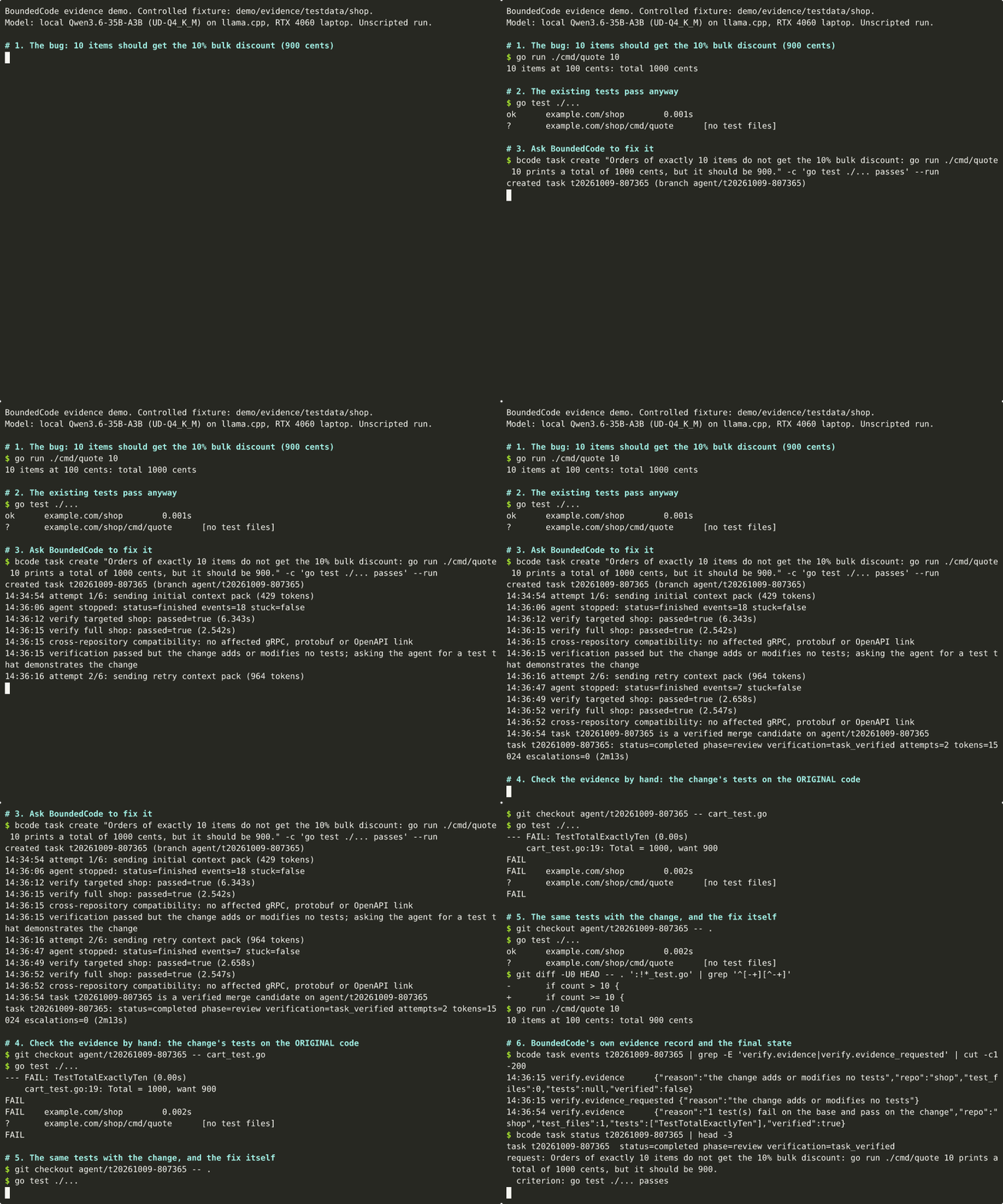
A real, unscripted run with the local Qwen3.6-35B-A3B on an RTX 4060 laptop, on a fixture made for the demo. Waits longer than 2 s are cut to 2 s, so 150 s plays in about 33 s; the timestamps on each line are real. Unedited log. One run on a toy fixture shows the mechanism, not a success rate.
The principle is not new. SWE-bench itself defines a task by tests that go from failing to passing. BoundedCode's contribution is applying that principle online, as a gate on an agent's own work, without knowing the answer in advance (section 7).
| Constraint | Consequence for the design |
|---|---|
| One laptop: Intel i7-13620H, RTX 4060 with 8 GB VRAM, 64 GB RAM, Debian 13 [R1] | The default local model, Qwen3.6-35B-A3B (a mixture-of-experts model), runs with most experts on the CPU. It decodes at 39.4 tokens/s with a 2 K-token prompt and 24.3 tokens/s with a 116 K-token prompt [R26]. Context has to be small and deliberate. |
| The agent's code is untrusted | Repository text can carry prompt injection. Every agent tool runs in a container. Verification is configured from the base commit, not from anything the agent can edit. |
| Long tasks must survive Ctrl-C, crashes and reboots | Durable state outside the model's conversation: the task ledger, not the chat, is the source of truth [R13]. |
| Nothing happens on the user's behalf | No push, merge or release. Work lands on agent/<task-id> branches in separate git worktrees. |
| Upstream tools move fast | Integrate, never fork: llama.cpp, OpenHands, codebase-memory-mcp and Serena run as separate processes or pinned dependencies [R5]. |
| Claims must be checkable | Every evaluation publishes its protocol, raw records and failures. |
flowchart LR
user([Engineer<br/>bcode CLI / TUI]) --> orch
subgraph host["Host: BoundedCode control plane (Go)"]
orch["Orchestrator<br/>run loop, budgets,<br/>strategy governor"]
ledger[("Task ledger<br/>SQLite, WAL, leases")]
ctx["Context planner<br/>budgeted packs"]
intel["Repository intelligence<br/>code graph, symbols,<br/>lexical search"]
verify["Verification engine<br/>stages, diff scope,<br/>secret scan,<br/>behavioural evidence"]
compat["Cross-repository<br/>compatibility gate"]
gw["Model gateway<br/>metering, budgets,<br/>cloud keys"]
frontier["Escalation policy<br/>Z1–Z4, sanitised packets"]
git["gitops<br/>hardened host git,<br/>integrity checks"]
end
subgraph sandbox["Docker container: --network none, no capabilities"]
adapter["OpenHands SDK adapter<br/>(Python, JSON-RPC over stdio)"]
tools["Agent tools:<br/>terminal, file edit"]
wt[("Task worktree<br/>agent/<id> branch")]
end
orch <--> ledger
orch --> ctx --> intel
orch <-->|"stdio JSON-RPC"| adapter
adapter -->|"llm.complete (tunnelled)"| gw
gw --> llama["llama.cpp server<br/>(local model)"]
gw -.-> cloud["Cloud API<br/>(optional)"]
adapter --> tools --> wt
orch --> git --> wt
orch --> verify -->|"stages run in a<br/>verification sandbox"| wt
verify --> compat
orch -.-> frontier -.-> codex["Codex CLI<br/>(optional, own container)"]
The binary is one Go program (cmd/boundedcode). It has 34 internal
packages, layered so that lower layers never import the CLI or the
orchestrator [R3]. One task runs as follows. Each step is in
Runner.Run [R6]:
- Create. The task row and worktree rows are written before the git worktree is created ("persist intent first").
- Start. The run acquires a lease, reconciles any orphaned attempt from a crashed run, computes secret masks and dependency mounts, and opens the agent session in the sandbox.
- Contract. The local model derives a task contract. A material ambiguity can stop the task to ask the user.
- Attempt. Each attempt starts from a fresh, budgeted context pack. The agent works under the wall-clock limit and a strategy governor.
- Checkpoint. The worktree's integrity is re-checked, then its changes are committed on the task branch.
- Verify. Targeted checks run, then the full checks, then the cross-repository gate, then behavioural evidence.
- Decide. The outcome is
task_verified(merge candidate),tests_green(reported as UNVERIFIED), retry, escalate, or block. A blocked task keeps its work and can be resumed.
| Capability | Origin | Integration |
|---|---|---|
| Agent loop and tools | OpenHands Software Agent SDK 1.51.0 | Its own Python process inside the sandbox. BoundedCode wrote the adapter (735 lines) and its versioned JSON-RPC protocol [R10]. |
| Local inference | llama.cpp v0.5.0 | A supervised llama-server process, with idle sleep and tuned mixture-of-experts offload [R5]. |
| Code graph and impact | codebase-memory-mcp 0.11.0 | A persistent MCP session over BoundedCode's own JSON-RPC peer, with a CLI fallback [R9]. |
| Symbol navigation (optional) | Serena 1.7.0 (MIT) | One read-only instance per worktree, pinned by a CI guard against its later GPL versions [R9]. |
| Secret scanning | gitleaks 8.30.1 | A verification stage. The full gate fails if gitleaks is missing. |
| Frontier escalation (optional) | Codex CLI | Runs in its own container; only sanitised packets are sent [R21]. |
| Task ledger, leases, crash recovery | BoundedCode | internal/task, internal/store, internal/orchestrator |
| Budgeted context planner, retrieval seed ranking | BoundedCode | internal/contextplan |
| Verification engine and behavioural evidence | BoundedCode | internal/verify |
| Sandbox policy, command policy, git integrity | BoundedCode (on Docker or Podman) | internal/sandbox, internal/policy, internal/gitops |
| Model gateway (metering, budgets, cloud translation) | BoundedCode | internal/inference |
| Cross-service analysis and compatibility gate | BoundedCode | internal/xservice, internal/compat |
| Strategy governor, task contract, escalation policy | BoundedCode | internal/orchestrator, internal/frontier |
Status: Validated for the pack mechanism (it ran in every evaluation). Implemented for individual retrieval paths, with unit tests.
The agent never receives the repository. Every attempt starts from a
context pack, built deterministically by contextplan.Build [R7]:
- Budget. 24,000 tokens by default.
- Sections. Ten, filled in priority order, each with a cap as a share
of the budget [R7]:
- task (10 %);
- advice from the frontier model (15 %);
- the failing verification output (25 %);
- rejected strategies (6 %);
- the current diff (25 %);
- impact (10 %);
- cross-service contracts (10 %);
- code (30 %);
- ADRs (8 %);
- rules (5 %).
- Overflow. A section that would get less than 50 tokens is dropped, and an oversized one is truncated with a marker.
- Three modes:
- initial;
- retry, which leads with the failure;
- resume, which states that the pack "was rebuilt from the task ledger, git and verification results; trust it over memory".
Retrieval is a chain that prefers the cheapest precise source
(requestSymbols [R8]):
- Names are ranked by seed ranking, which demotes common sample names.
- Compiler and test diagnostics are located by fixed-string search.
- In multi-repository tasks, the code graph decides which repository mentions a name.
- Serena answers symbol queries in the task's worktree.
- If Serena is unavailable, the code graph's snippet and callers are used.
- A bounded whole-word ripgrep is the last resort.
Impact queries run against an index of the task worktree, so they see the agent's changes.
Integration choice. ADR-0006 replaced one-shot calls to the code-graph CLI with a persistent MCP session after a measurement: about 4 s per query for the CLI, against about 12 ms per query for the session [R9].
Measured context use (held-out validation, upper bounds including all tool output) [R30]:
| Repository | Size, in estimated source tokens | Context used |
|---|---|---|
| prometheus | 1.83 M | 29.2 K tokens (1.6 %) |
| vuejs/core | 1.22 M | 33.2 K (2.7 %) |
| gin | 0.12 M | 35.0 K (29.1 %) |
All six tasks used roughly 18–35 K tokens each, whatever the repository's size.
Trade-off. A small pack means the agent must read further code through its tools, so the pack's quality matters more than its size. The targeted engineering pass added retrieval seed ranking for exactly this reason [R29].
Status:
- Implemented with a real-process crash test.
- Validated once on a real task: a resume with 4 context condensations on Prometheus [R27].
The ledger is the source of truth (ADR-0002) [R13]:
- Storage. Embedded SQLite through the pure-Go
modernc.org/sqlite, in WAL mode, with append-only migrations. - Persist then act. Every transition is written before its side
effect:
- the worktree row before the worktree;
- the attempt counter and an "in progress" strategy row before the agent's turn;
- the escalation row before the question is sent.
Leases (AcquireLease [R12]):
- Acquiring. A single conditional
UPDATEclaims the task if it is free, already ours, or its heartbeat is stale. - Renewing. A heartbeat every 15 s.
- Taking over. A second process takes over only after 2 minutes of silence.
- Cancellation. A cancellation is never overwritten by a late save.
Crash recovery is tested with a real SIGKILL (TestSIGKILLResume
[R14]):
- The test re-executes itself as a child runner whose agent writes a file
and hangs, then kills the child with
SIGKILL. - While the lease is fresh, a second runner is refused.
- Once the lease is stale, a third runner takes it over and marks the orphaned attempt "rejected: previous run stopped".
- The killed attempt's edits are still there.
- The third runner finishes the task from a pack rebuilt from the ledger.
Caveat: the agent in this test is scripted, not the OpenHands adapter.
Budgets and runaway control:
- Per task: 6 attempts, 4 hours of wall clock and 4 M local tokens.
- Per response: an 8,192-token output cap.
- Strategy governor [R15]: it stops an attempt that generates
40 K tokens without progress, or exceeds 50 K tokens or 35 minutes. The
stop is recorded and that strategy is not retried.
- Why it exists: in development, "72–109 K generated tokens per unproductive attempt" were observed [R29].
- Status: Implemented, but no live stop has been observed in an evaluation [R4].
- Infrastructure failures (an unreachable model server, cloud 429 or 5xx) are retried without using up an attempt. Authentication failures block the task immediately.
The agent boundary (ADR-0004) [R10]:
- Protocol. The Python adapter speaks newline-delimited JSON-RPC 2.0
over the container's stdio. LiteLLM inside it points at a loopback
proxy that turns every model call into an
llm.completerequest back to the Go gateway. - Why it matters:
- the sandbox needs no network at all;
- all metering and budget enforcement happens on the host;
- cloud API keys never enter the container.
- Protocol versioning. Both sides refuse a mismatched protocol version.
Task contract (experimental) [R16]:
- The local model derives the requirements before the first attempt.
- A second call checks each "material ambiguity" against quotes from the request.
- By default, a material ambiguity stops the task to ask.
- Status: Partial. In the held-out run, 2 of 6 derivations were empty and 1 of 6 flagged a false ambiguity [R4].
Frontier escalation (ADR-0009) [R21]:
- Policy. A deterministic Z1–Z4 policy decides when to ask a stronger model. "No model decides whether to escalate."
- Packets. They are compacted and redacted, host paths are rewritten, and a fail-closed check refuses any packet that still contains a home directory path.
- Status: Implemented, value unproven.
- Tested against a fake, with one live run.
- In the first validation it sent 4 questions, and none of those tasks was accepted.
- In the held-out validation it never triggered [R1].
Status: Validated. It decided every result in the held-out and comparative evaluations.
flowchart TD
A["Agent's change committed<br/>on agent/<id>"] --> B["Config and presets read<br/>from the BASE commit"]
B --> C["Targeted stages<br/>(impacted packages)"]
C --> D["Full stages + diff scope<br/>+ gitleaks + compat gate"]
D -->|fail| R["Retry with the failure<br/>leading the next pack"]
D -->|pass| E{"Does the change add<br/>or modify tests?"}
E -->|no| Q["Ask the agent once<br/>for a demonstrating test"]
E -->|yes| F["Tree 1: base + changed tests<br/>Tree 2: pristine base (control)"]
F --> G{"A changed test fails on tree 1,<br/>does not fail on tree 2,<br/>and passes on the change?"}
G -->|yes| V["task_verified<br/>(merge candidate)"]
G -->|no| T["tests_green<br/>(reported UNVERIFIED)"]
Q --> E
The design has four parts.
1. The agent cannot weaken its own gate [R17, R18].
- Configuration from the base commit. The verification configuration
(
.boundedcode/verification.yaml) is read from the base commit withgit cat-file, never from the worktree. - Fallback presets. Without a configuration, presets are chosen from the base commit's file list. They cover Go, JavaScript/TypeScript, Python, Rust, Java, C/C++, Ruby, PHP, Terraform and Helm.
- Protected paths. A change to
.boundedcode/, CI workflows, CODEOWNERS or.gitmodulesfails the diff-scope stage. - Deleted requirements. Deleting a file a stage requires fails that stage.
- Tested:
TestAgentCannotWeakenVerification.
2. Checks are deterministic and sandboxed.
- Where stages run. In their own container: offline, with read-only dependency mounts, a per-task build cache, and command policy applied to every stage.
- Side effects. Anything verification writes is undone afterwards; an undo that fails is a failure.
- Secret scanning. The task's diff is piped to gitleaks. If gitleaks is missing, the full gate errors instead of passing [R18].
3. Behavioural evidence (Engine.BehaviourEvidence [R19]). The
evidence check builds two trees from the base commit:
- base + changed tests: the change's added or modified test files laid over the base;
- control: the pristine base.
A test counts as evidence only when all three of these hold:
- It fails with the changed tests on the base. A failure to build on the base is recorded as "not built" and is not evidence. Testing new API that does not exist on the base proves nothing about behaviour.
- It does not fail in the control. A failure the base already had does not count.
- It passes on the change. For Go, each candidate is re-run with
-run ^(names)$ -vand must report--- PASS. A skipped test does not count. This rule closed audit finding H2 [R33].
Attribution.
- Go: per test function, including test data. A changed file
under
testdata/is attributed to the package whose tests read it, which fixed the held-out validation's false negative [R30]. - Ten other runners: per test, with the failure parsed from the runner's output. The runners are pytest, unittest, cargo, Maven Surefire, Gradle, minitest, RSpec, PHPUnit, CTest and Meson.
- JavaScript and custom stages: per stage.
Tested. TestBehaviourEvidenceGoCases covers eight cases [R20]. Among
them:
- a test that already passes on the base;
- a test of new API that does not build there;
- a failure the base already had;
- a test skipped on the change;
- a data-driven test in a sub-package.
4. Outcomes are named honestly.
task_verified: every check passed and evidence exists.tests_green: every check passed but evidence does not exist. It is reported as "UNVERIFIED candidate: checks are green but …", with the reason. The task finishes, but is not called verified.
The project states these limits in its own docs [R17, R33]:
- It cannot tell which reading of an issue is right. A test can encode the wrong one of several valid readings and still provide evidence.
- Python and JavaScript tests of newly added API can count as evidence. The "does not build on base" guard is reliable only for Go (audit finding H4, open).
- Flaky tests can become evidence (audit finding M2, open).
Status:
- Implemented, with adversarial tests.
- Validated in the sense that every evaluation run executed inside the sandbox.
- The live container-escape probes need the sandbox image. They have run locally. A weekly CI job for them was added on 2026-10-10 and has not run yet.
Threat model. The model may be wrong or adversarially steered. Text in the repository can instruct it [R22]. Agent-level permission prompts are explicitly not treated as a security boundary (ADR-0003).
| Layer | Control | Reference |
|---|---|---|
| Container | --network none, --cap-drop ALL, no-new-privileges, a PID limit, memory and CPU limits, a private tmpfs $HOME. Mounting /, $HOME, the Docker socket, ~/.ssh or cloud and package-manager credential paths is refused. |
Container.Args [R23] |
| Secrets in the worktree | .env*, keys and credential files are masked with an empty read-only file or a 0500 tmpfs. More than 500 matches refuses the run instead of partly masking. |
internal/policy [R24] |
| Model traffic | Tunnelled over stdio; the container has no network. Cloud keys stay on the host gateway, in the OS keyring. | ADR-0004, ADR-0010 |
| Commands in verification | A deterministic policy blocks push, hard reset, protected-branch merges, terraform apply, mutating kubectl and helm, publishing, and curl … | sh. It first normalises wrappers, global flags and sh -c bodies, so obfuscations like git -C . push or bash -lc "FOO=1 git push" are caught. |
CheckCommand [R24] |
| Host git | Hooks, fsmonitor and ext protocols are off, and submodules are ignored. Before any host git call, the worktree's .git pointer, its admin directory, commondir and HEAD are verified. Nested repositories are refused. File names are read NUL-separated. |
gitops [R11] |
| Host-side reads | Context packs never follow a symlink out of the worktree or read a secret path. | ReadConfined [R7] |
Adversarial tests:
TestPromptInjectedAgentIsContained[R22] scripts an agent that tries three attacks, and each is contained:- it rewrites the verification config: rejected;
- it plants
leak.go -> id_ed25519: the canary never reaches a pack; - it pushes: refused by policy.
TestAdversarialContainer[R23] probes from inside the real container:- reading masked files;
- a host environment canary;
- the host
$HOME; - an HTTP request to
1.1.1.1; - the Docker socket;
- the capability set and the user.
A critical finding, and its fix. The readiness audit (2026-10-09) found a way past these controls [R33]:
- The attack. An agent could create a nested git repository inside its
worktree, with a malicious clean filter in that repository's own config.
The host's
git statusandgit add -Athen ran that filter on the host. This was reproduced with git 2.47.3. - The fix (commit
48274a1):- host git ignores submodules;
- a checkpoint refuses a worktree holding a nested repository;
TestNestedRepositoryConfigNotExecutedguards it.
- A related high-severity finding in the same commit: git's C-quoted
file names (for example a new
.github/workflows/cié.yml) slipped past the protected-path policy. - Shipped in v0.1.0-alpha.5.
Open residual risks [R22]. The design document lists 15. The most material:
- Secrets in git history. Secrets committed to git history, and
tokens in
.git/config, remain readable inside the sandbox, because the object store is mounted read-only rather than masked. - Agent-writable build scripts. They are agent-writable, so verification catches mistakes, not an adversary.
- The frontier container. It has network access and the Codex credentials.
- Container escape itself is out of scope.
- Root. The container runs as the invoking user, so it runs as root only if BoundedCode itself does. Nothing refuses UID 0.
Status:
- Implemented, tested on fixtures, with one real-CLI run on the fixture with Docker.
- Not run on a real multi-repository task [R4].
The problem. In a multi-repository task, each repository's own tests can pass while the contract between them breaks. For example, a protobuf field is renamed in the provider, but a consumer in another repository still builds against its vendored generated code.
How the gate works [R32]:
- Detection. The cross-service analyser (
internal/xservice) finds links between the task's repositories. The gate evaluates gRPC, protobuf and OpenAPI links. - Exported trees. The base and head commits of every repository are
exported with
git archive; the worktree is never read directly. - Structural comparison:
.protodefinitions: removed, renumbered, retyped or renamed fields, removed enum values and changed RPC signatures are breaking;- OpenAPI: operations are compared together with the schemas they reference;
- Go code: compared by enclosing function.
- Real execution. The consumer's tests run in the sandbox against the
candidate provider, through a generated
go.work, with coverage. "Exercised" means coverage blocks in the provider were hit. OpenAPI links use a knock-out run: remove the operation and see whether a test fails. - Verdicts:
compatible: every need was exercised and passed;broken: a consumer still uses a removed definition, or a failure is attributed to the provider;untested: anything else, with a reason.
- Effect on the outcome. Anything other than
compatiblewithholdstask_verified.
Tested:
TestBreakMissedBySingleRepositoryTestsshows the motivating case: every repository is green on its own, and the gate reportsbroken.TestGateBypassAttemptscovers three bypasses:- editing the verification config;
- a
replacedirective pointing at a stale copy; - a private copy of the generated code.
Prior art. Schema-level breaking-change detection exists, for example
buf breaking for protobuf. What the gate adds is executing the
consumers against the candidate provider, inside the same sandbox and
evidence model as the rest of verification.
Limits [R32]:
- Go sides only for gRPC and protobuf, and no nested Go modules.
protocis never run.- A client is never run against a real server.
| Decision | Chosen | Rejected, and why | Source |
|---|---|---|---|
| Relationship to upstream tools | Integrate as processes and pinned dependencies | Forking would mean maintaining fast-moving upstream code | ADR-0001 |
| Control-plane state | Embedded SQLite (WAL) | PostgreSQL: a service to run, for a single-user tool. The case study's section 13 notes when that changes. | ADR-0002 |
| Isolation | Container per agent session | Agent permission prompts: not an isolation boundary | ADR-0003 |
| Agent transport | JSON-RPC over stdio | Unix socket: a socket bind-mounted from the host does not reach the container under Docker Desktop (the ADR's recorded reason). Localhost HTTP was the third option considered. Stdio also needs no network path at all, so the container keeps --network none. |
ADR-0004 |
| Code-graph access | Persistent MCP session | One-shot CLI: about 4 s per query, against about 12 ms | ADR-0005 → ADR-0006 |
| Symbol navigation | One read-only Serena per worktree, optional | One instance per task: wastes language-server warm-up. One instance switching projects: serialises everything and risks wrong-project answers. Symbol editing: a cold TypeScript rename changed only the declaration. | ADR-0008 |
| Default model | Qwen3.6-35B-A3B | Laguna XS 2.1 solved 11 of 11 synthetic tasks and 4 of 4 hard repeats, against Qwen's 10 of 11 and 1 of 4. But it was 2.6× slower (7.0 vs 18.2 verified tasks/hour), and its license (OpenMDW-1.1) is not on the SPDX list. Speed was chosen, relying on verification to catch the weakness. | ADR-0007 [R26] |
| When to escalate | Deterministic Z1–Z4 policy | Letting a model decide: not auditable, not budgetable | ADR-0009 |
| Verification strictness | Evidence required for task_verified |
Accepting green checks: produced 4 of 8 false passes in the first validation. The cost: correct changes without a demonstrating test end tests_green. That was 3 of BoundedCode's 8 runs in the comparative evaluation. |
[R27, R31] |
| Formatting and lint in the gate | The project's own checks are enforced | Ignoring them: they are the project's rules. The cost: some correct patches are rejected for formatting (section 11). | [R31] |
| Context | Budgeted packs | Whole-repository prompts: do not fit a local model, and are expensive on frontier models | [R7] |
Every evaluation used public SWE-bench-style tasks:
- Hidden tests. Success was decided by the dataset's hidden acceptance tests, applied after the run and never visible to the agent.
- Setting. One machine, the local model, one run per task.
- Publication. Raw records, failures and errata are in the repository [R2].
| Evaluation (date) | Tasks and selection | Result | What it shows |
|---|---|---|---|
| Initial validation (2026-10-04) [R27] | 8 tasks. Fixed hash ranking per slot, screened for environment validity only. | 0/8 on the frozen build, with 4 false verification passes. 1/8 after fixing five BoundedCode defects. | Green checks are weak evidence; it motivated behavioural evidence. |
| Failure-driven pass (2026-10-05) [R29] | The same 4 failed tasks plus one control. Development evidence, not validation. | 1 of 4 development tasks; 3 false passes (each an issue/hidden-test mismatch) | The evidence gate stopped no-op passes, but not passes where the issue allows another reading. |
| Targeted pass (2026-10-05) [R29] | 2 development tasks | 0 of 2 (0 of 3 runs) | It added runaway control, the task contract and retrieval seeds; no measured gain. |
| Held-out validation (2026-10-05) [R30] | 6 tasks from 24 hash-ranked candidates. 10 were rejected because their hidden tests could not be derived from the issue. Frozen before the first run. | 5 of 6 task_verified and passing hidden tests, all with the local model only. 6 of 6 hidden tests passed. 0 false passes; 1 false negative. |
The gate behaves as designed on screened tasks. 95 % interval for 5 of 6: about 36–99.6 %. |
| Comparative evaluation (2026-10-09/10) [R31] | 8 tasks with no difficulty or clarity screening, 6 from repositories never used in development. A frozen protocol and deviations log. | Hidden tests: BoundedCode 7 of 8, plain agent 6 of 8. | No success difference shown (McNemar p = 1.0). The single discordant task changed between two runs of the baseline. |
This is the project's strongest piece of evidence, because it includes a baseline [R31]:
- Baseline. The same OpenHands SDK, model, sandbox and 60-minute limit, without BoundedCode.
- Pre-registration. The protocol, task set and tooling were committed before any comparative run.
- Deviations. Three changes after the freeze were documented and
committed before the runs they affect.
- One was a harness defect that had denied the baseline its build environment. That arm was re-run, and both arms are published.
Results:
- Cost. BoundedCode used 2.3× the wall-clock time (126 vs 56 minutes) and 2.1× the processed tokens (862 K vs 413 K).
- The gate on the plain agent's 16 patches (replay):
- it accepted 8, and all 8 pass the hidden tests;
- it rejected 8: all 4 that fail the hidden tests (a compile error, a broken existing test, a test run out of memory, formatting), and 4 that pass. Two of those were rejected for formatting, and two for breaking an existing test that the dataset's own reference fix also breaks.
- It found no defect that the hidden tests missed. A draft claim that it had was checked against the reference fix and withdrawn.
- The gate on BoundedCode's own runs:
- one false verification (gin-3820): the hidden test checks a different layer than the issue names;
- three missed verifications of correct changes: two repositories had no usable test stage offline, and in one the agent's test also passed on the base.
Reading. On this sample, BoundedCode's architecture shows no success advantage. Its verification gate is a reliable reject filter: every failing patch was rejected. But it rejects as many correct patches, and behavioural evidence predicts hidden-test success no better than green checks (6 of 7 against 11 of 12). These are eight tasks, one run each, and the report does not extrapolate.
The reports document 12 cases where verification or self-verification passed but the hidden tests failed [R27–R31]:
- 6 came from the earlier gate design, before behavioural evidence; that is the motivating failure.
- 5 came from development runs with the current design:
- four are issue/test mismatches: the hidden test requires a detail the issue does not state, or one of several valid readings;
- one (caddy, targeted pass) was credited on changed tests that did not build against the base. That is a weaker signal, which the gate no longer accepts as evidence.
- 1 came from the comparative evaluation, an issue/test mismatch like the four above.
None of the six later cases is a no-op patch, the class the evidence gate was built to stop.
Limitations stated by the project [R1, R4]:
- The sample is small. 8 + 6 + 8 public tasks, each run once, on one machine with one model. Variance between runs was not measured, though the comparative evaluation shows it is large.
- No baseline advantage. No baseline advantage has been shown, either in the 2-task baseline or in the 8-task comparative evaluation.
- Platforms. macOS and Windows are experimental. In CI, 5 test packages fail on macOS and 14 on Windows. Four of the causes are filed as first-contribution issues.
- Unmeasured features:
- Cloud model providers: no live API calls or real tasks yet;
- hardware-based model choice: profiles not benchmarked;
- frontier escalation: no shown benefit;
- the strategy governor: no live stop observed;
- the cross-repository gate: never run on a real task.
- Open audit findings [R33]:
- secrets readable through the git object store;
- non-Go new-API tests counting as evidence;
- flaky tests as evidence;
- a race window between the worktree check and host git (reasoned, not reproduced);
- case-sensitive secret-name matching.
Unresolved questions:
- Does behavioural evidence improve outcomes, or only labelling? The comparative data shows it labels conservatively, but no ablation has measured its effect on success.
- Would the gate's defect detection translate into better outcomes if the agent were told what the gate found? BoundedCode's own runs never needed that path.
- How much of the held-out 5 of 6 comes from screening? The screen removed tasks whose hidden tests need identifiers that only the reference fix introduces, a failure class seen in development.
- Is the 2× cost acceptable for any measurable gain? None has been shown yet.
Lessons:
- Measure the gate, not just the agent. The first validation's most useful output was not its score of 0/8. It was the discovery that 4 of 8 "verified" results were false, which the 0/8 alone would not have shown.
- Strictness has a price you must report. Requiring evidence removed
no-op false passes, but correct changes now end
tests_greenwhen no demonstrating test is possible offline. Publishing that cost is part of the result. - A harness defect can bias a comparison. The baseline's missing build environment (deviation D3) would have handed BoundedCode a win on one task. Re-running that arm and publishing both arms was the only defensible fix.
- With small samples, variance dominates. The identity of the one task where the two systems differed changed between two baseline runs. Single-run differences on 8 tasks should be read as noise until repeated.
- Check your own claims against the reference. A draft finding (a regression "missed by the hidden tests") was withdrawn after checking it against the dataset's reference fix.
- Security review finds what tests do not. The critical nested-repository escape survived a test suite full of adversarial cases. It was found by reasoning about what host git does inside an agent-writable tree.
Future validation priorities, in order:
- Repeated runs on a larger, unscreened task set, with enough tasks to detect a 10–15 point difference.
- An ablation of behavioural evidence on the same tasks: gate on vs gate off.
- The cross-repository gate on real multi-repository tasks.
- macOS and Windows: green unit tests, then the full flow.
- The non-Go evidence gaps: new-API tests and flaky tests.
At larger scale. The single SQLite ledger and per-machine sandbox suit a single-user tool. Running many engineers' tasks would first need a shared task store with real leases (for example Postgres with row locks) and a scheduler for GPU time. The state boundaries were drawn so those parts can change without touching the verification gate.
Status: Implemented and measured [R36].
- Built in CI. Releases are built by a GitHub Actions workflow from a
pushed tag. It runs the tests and
make dist, attests every file with SLSA build provenance (Sigstore), and creates a draft that the maintainer publishes. - Rebuilt independently. v0.1.0-alpha.5 was rebuilt locally from its
tag:
- all 6 binaries and all 6 SBOMs were byte-identical to the release;
- the licenses archive was identical under
umask 022. A permission-bit difference under another umask was found and fixed for future releases. - All 14 assets pass
gh attestation verify.
- Pins. Upstream components are pinned by commit and checksum.
- CI checks:
- govulncheck, license checks and gitleaks over the full history;
- a DCO sign-off on every commit.
All links point at tag v0.1.0-alpha.5 (commit 5e1bea4) unless stated
otherwise. The base URL is
https://github.com/akynte/boundedcode/blob/v0.1.0-alpha.5/.
| Ref | What | Link |
|---|---|---|
| R1 | README: reference hardware, "How this was built", known limitations, frontier status | README.md |
| R2 | Evaluation overview | docs/benchmarks/README.md |
| R3 | System architecture | docs/architecture/system-architecture.md |
| R4 | Implementation status (implemented, experimental, planned) | docs/development/status.md |
| R5 | Upstream components and pins | docs/architecture/upstream-components.md |
| R6 | The run loop, Runner.Run |
internal/orchestrator/runner.go#L202 |
| R7 | Context pack sections, budgets, Build, ReadConfined |
internal/contextplan/plan.go#L92, #L109, #L447 |
| R8 | Retrieval chain, requestSymbols |
internal/contextplan/symbols.go#L81 |
| R9 | ADR-0006 (persistent MCP session) and ADR-0008 (Serena) | 0006, 0008 |
| R10 | ADR-0004 (adapter protocol); the llm.complete tunnel |
0004, runtime.go#L210 |
| R11 | Host git hardening, CheckWorktree, checkNoNestedRepos, TestNestedRepositoryConfigNotExecuted |
git.go#L32, #L300, #L345, git_test.go#L256 |
| R12 | Leases, AcquireLease |
internal/task/task.go#L209 |
| R13 | ADR-0002 (embedded SQLite) | 0002 |
| R14 | TestSIGKILLResume |
internal/orchestrator/crash_test.go#L50 |
| R15 | Strategy governor | internal/orchestrator/governor.go#L60 |
| R16 | Task contract and ambiguity gate | internal/orchestrator/contract.go#L190 |
| R17 | Verification guide (outcomes, evidence rules, limits) | docs/usage/verification.md |
| R18 | Config from the base commit (LoadConfig), diff scope, secret scan, TestAgentCannotWeakenVerification |
verify.go#L190, #L362, #L394, verify_test.go#L112 |
| R19 | Behavioural evidence, BehaviourEvidence and goTestsPass |
delta.go#L124, #L375 |
| R20 | Evidence test cases | delta_test.go#L111 |
| R21 | ADR-0009 (frontier escalation); frontier.Evaluate |
0009, policy.go#L57 |
| R22 | Sandbox design: controls and residual risks; TestPromptInjectedAgentIsContained |
docs/design/sandbox.md, adversarial_test.go#L24 |
| R23 | Container arguments; TestAdversarialContainer |
sandbox.go#L163, adversarial_test.go#L13 |
| R24 | Command policy and secret and protected paths | policy.go#L210, #L231 |
| R25 | Evidence demo: scenario, recording, unedited log | demo/evidence/README.md |
| R26 | Model evaluation and decode-speed reference run; ADR-0007 | model-evaluation.md, infra report, 0007 |
| R27 | Initial validation (0/8, then 1/8) | small-real-world-validation-2026-10.md |
| R28 | Two-task baseline | baseline-comparison.md |
| R29 | Failure-driven and targeted engineering passes (development evidence) | failure-driven, targeted |
| R30 | Held-out validation (5 of 6) | second-independent-validation-2026-10.md |
| R31 | Comparative evaluation: protocol, deviations, report, raw results | report.md, protocol.md, deviations.md, results/ |
| R32 | Cross-repository compatibility design; gate tests | cross-repo-compatibility.md, gate_test.go#L253, #L498 |
| R33 | Readiness audit (C1, H1–H6, M1–M7) | readiness-audit.md |
| R34 | Fix commits: behavioural evidence (add3aab), nested repositories and quoted names (48274a1), evidence must pass (93c784b), compatibility gate (a41ac79) |
add3aab, 48274a1, 93c784b, a41ac79 |
| R35 | Release v0.1.0-alpha.5 and its assets | release page |
| R36 | Release workflow; release process and verification, including the measured rebuild (on main, after the tag) |
release.yml, release.md (main) |