


AssemblyTheoryTools (ATT) provides a unified Python interface for assembly-index calculations across molecules, strings, and arbitrary graphs.
Documentation · Examples · API reference · PyPI · Issues · Releases
What is assembly theory?
Assembly theory quantifies the complexity of an object by the smallest number of joining steps needed to build it from elementary parts, while allowing previously created intermediates to be reused. The reuse rule captures internal structure and repetition rather than size alone.
For molecules, the elementary parts are bonds and the calculation is performed on the molecular graph. ATT exposes the assemblyCPP C++ calculator, the assembly-theory Rust calculator, and assemblycfg for fast approximate string calculations through one Python package.
See the concepts guide and theory overview for more background.
ATT requires Python 3.12 or newer. Install the current release from PyPI:
python -m pip install assemblytheorytoolsPlatform note: The bundled C++ calculators target Linux x86-64. On Windows, use WSL; on other platforms, provide a compatible assemblyCPP build as described under Use a custom assemblyCPP build below.
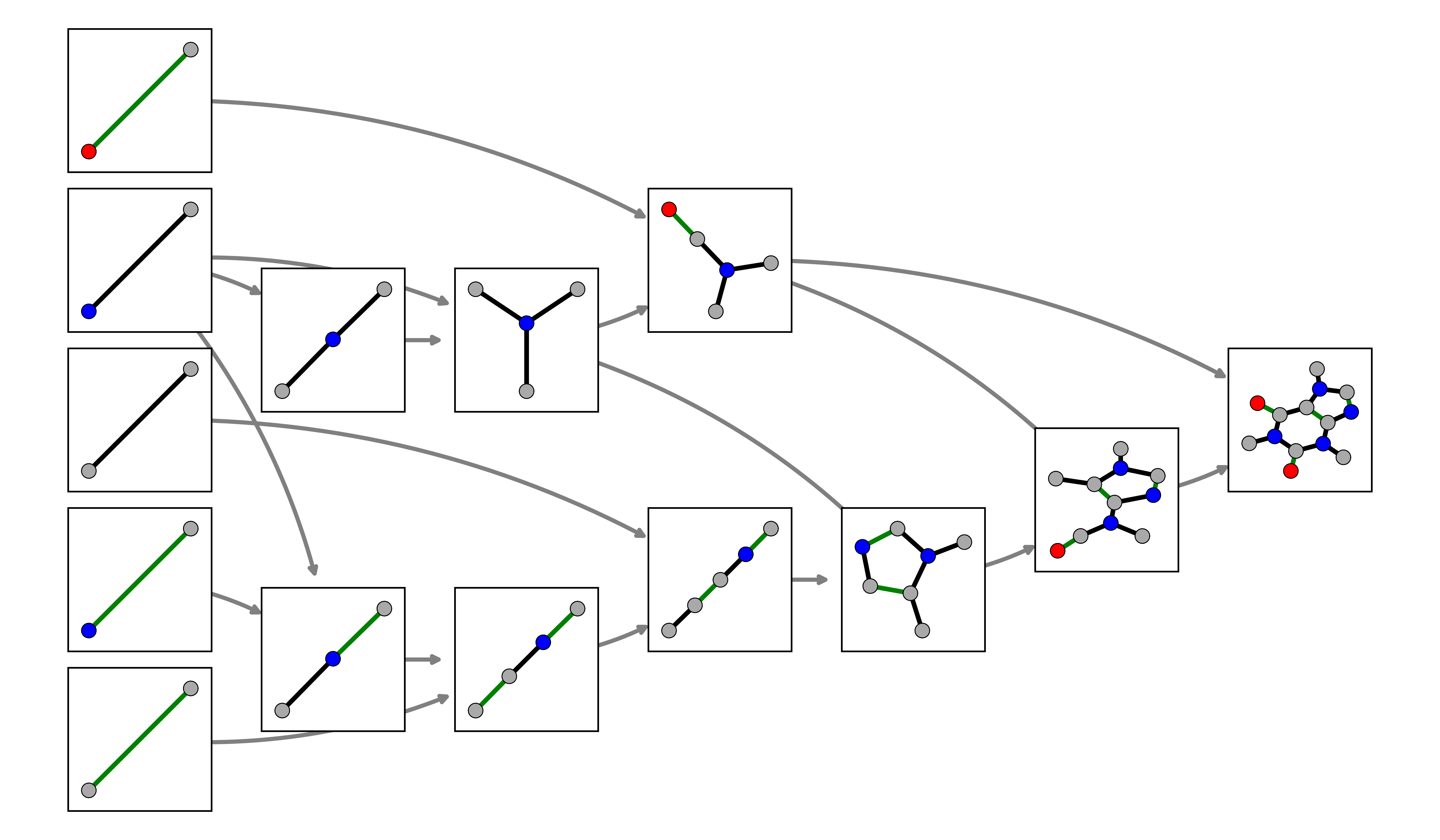
Calculate and plot the assembly pathway for caffeine:
import matplotlib.pyplot as plt

import assemblytheorytools as att

smi = "CN1C=NC2=C1C(=O)N(C(=O)N2C)C"
graph = att.smi_to_nx(smi)

ai, virtual_objects, pathway = att.calculate_assembly_index(
    graph,
    strip_hydrogen=True,
)

print(f"Assembly index: {ai}")

fig, ax = att.plot_pathway(pathway, plot_type="graph")
plt.show()
Assembly index: 9
Understanding the result
aiis the assembly index.virtual_objectscontains reusable intermediates found along the pathway. The collection is unordered; do not rely on positional order.pathwayis a NetworkXDiGraph: its nodes are virtual objects and its directed edges are joining operations.
Convert the virtual-object graphs back to SMILES with:
virtual_smiles = [
    att.nx_to_smi(obj, add_hydrogens=False)
    for obj in virtual_objects
]
Most published molecular assembly indices exclude hydrogens. Use strip_hydrogen=True when comparing against those
values. ATT strips a copy, leaving the original graph unchanged.
Which function computes which quantity. The route map carries the full table — every quantity ATT computes, with its inputs, its outputs, and what it is used for.
| Quantity | Function | Input | Output |
|---|---|---|---|
| Assembly index | calculate_assembly_index |
NetworkX graph or RDKit Mol |
Index, virtual objects, pathway |
| Assembly index without the pathway | calculate_assembly_index_rust |
NetworkX graph or RDKit Mol |
Index (hydrogens always stripped) |
| String assembly index | calculate_string_assembly_index |
String or list of strings | Index, virtual objects, pathway |
| Joint assembly index | calculate_assembly_index on a joined graph |
Graphs merged with join_graphs |
Index for the whole set |
| Shared-assembly score | calculate_assembly_index_similarity |
List of graphs | Score; 0 to 1 for a pair |
| Semi-metric distance | calculate_assembly_index_semi_metric |
Two graphs | Distance; negative means cheaper together |
Assembly A |
calculate_assembly |
Graphs and their copy numbers | Ensemble assembly value |
| Assembly depth | calculate_assembly_depth_rust |
NetworkX graph or RDKit Mol |
Minimum depth under concurrent joins |
| Bounds | calculate_assembly_index_upper_bound, calculate_assembly_index_lower_bound |
NetworkX graph or RDKit Mol |
Instant bounds for screening |
| Many indices at once | calculate_assembly_index_parallel |
List of graphs | Indices, virtual objects, pathways |
| Assembly index from tandem MS | MAEstimator |
Fragmentation tree and molecular weight | Monte Carlo samples of MA |
| Assembly index from IR peaks | estimate_ai_from_ir_peaks |
Peak counts and reference indices | Fitted model and predicted indices |
| Other complexity scores | bertz_complexity, bottcher, wiener_index, and more |
RDKit Mol |
Score, for comparison against the index |
- Exact assembly-index calculations for molecules, arbitrary labelled graphs, and directed or undirected strings.
- Default C++ and alternative Rust search interfaces, plus fast graph bounds and CFG-based string approximations.
- Joint assembly, parallel execution, pathway parsing, pathway visualisation, and alternative-path enumeration.
- Molecular complexity metrics, structure conversion, reassembly, crystal-cell, spectroscopy, and mass-spectrometry utilities.
Calculator backends and important differences
| Backend | Main interface | Best suited to | Result |
|---|---|---|---|
| assemblyCPP (C++) | calculate_assembly_index |
Default molecule and graph calculations | Index, virtual objects, and pathway |
| assembly-theory (Rust) | calculate_assembly_index_rust |
Fast molecular index calculations | Index |
| assembly-theory search (Rust) | calculate_assembly_index_rust_search |
Search statistics, options, and supported pathway reconstruction | Structured search result |
| Graph bounds | calculate_assembly_index_upper_bound and calculate_assembly_index_lower_bound |
Fast size-based estimates | Upper or lower bound |
| assemblycfg | String calculations with mode="cfg" |
Fast approximate string calculations | Upper bound and pathway |
The Rust backend always strips hydrogens. For a meaningful comparison, compare it with
calculate_assembly_index(..., strip_hydrogen=True).
The PyPI distribution contains precompiled assemblyCPP executables for Linux x86-64. On Windows, use the Windows
Subsystem for Linux (WSL). On another platform, build assemblyCPP for that platform and set ASS_PATH to the full path
of its executable. See configuration for all
backend options and environment variables.
The one-line PyPI install above resolves ATT's runtime dependencies. The authoritative dependency list and minimum
versions live in
pyproject.toml.
Install from source for development
git clone https://github.com/ELIFE-ASU/assemblytheorytools.git
cd assemblytheorytools
python -m pip install -e ".[dev]"
pytest
Install .[docs] instead of .[dev], or install both extras, to build the documentation:
python -m pip install -e ".[dev,docs]"
make -C docs strict
See
CONTRIBUTING.md
for the full development workflow.
Use a Conda environment
Create an isolated environment, then install ATT with pip so the package metadata remains the single source of truth for its dependencies:
conda create -n att -c conda-forge python=3.13
conda activate att
conda config --env --set channel_priority strict
python -m pip install assemblytheorytools
For development, clone the repository and replace the final command with python -m pip install -e ".[dev]".
Install on an HPC system (including SOL)
Module names vary between systems. On SOL, a typical setup is:
module load mamba/latest
mamba create -n att -c conda-forge python=3.13
source activate att
python -m pip install assemblytheorytools
When submitting a scheduled job, use the environment's Python executable explicitly:
srun "$HOME/.conda/envs/att/bin/python3" my_script.pyUse a custom assemblyCPP build
The bundled C++ executables are generic Linux x86-64 builds. A platform-specific build is required elsewhere, and an optimised local build can be faster on supported hardware.
Set ASS_PATH to the full path of the executable, not its containing directory:
export ASS_PATH=/absolute/path/to/asscppIf you also build the dedicated string calculator, set:
export ASS_STR_PATH=/absolute/path/to/string-calculatorFor the maintained Intel oneAPI recipe, including the compiler and Boost setup, see the installation guide.
Optional: configure ORCA
ORCA is only required by energy and geometry-optimisation helpers in
assemblytheorytools.tools_atoms; ordinary assembly-index calculations do not use it. ORCA is free for academic use but
requires registration.
After downloading and extracting the appropriate ORCA build, point ATT at the executable:
export ORCA_PATH=/absolute/path/to/orcaSee the installation guide for the complete setup.
Verify the installation
import assemblytheorytools as att

print(att.__version__)
print(
    att.calculate_assembly_index(
        att.smi_to_nx("CCO"),
        strip_hydrogen=True,
    )[0]
)
The second line prints 1, the assembly index of hydrogen-stripped ethanol.
| Resource | Description |
|---|---|
| Route map | Every ATT quantity with its inputs, outputs, and applications |
| Concepts | Assembly indices, virtual objects, pathways, joint assembly, and backends |
| User guide | Molecules, strings, graphs, pathways, parallel runs, complexity, and mass spectrometry |
| Runnable examples | Basic and advanced scripts included with the repository |
| Published protocols | Jupyter notebooks reproducing published workflows end to end, committed with their outputs |
| Configuration | Environment variables, binaries, graph requirements, and search options |
| API reference | Complete module and function documentation |
Found a bug or have a feature request? Open an issue in the GitHub tracker. Bug reports should include the ATT version, Python version, operating system, and a minimal reproducible example.
Contributions are welcome. Read
CONTRIBUTING.md
before opening a pull request.
Contributors and acknowledgements
- Louie Slocombe — orchestration, development, and conceptualisation
- Gage Siebert — string assembly-index calculations and CFG integration
- Estelle Janin — bonding and joint assembly-index calculations
- Joey Fedrow — development, maintenance, and documentation
- Veronica Mierzejewski — integration of reassembly calculations
- Mohammadreza Shahjahan — branding and development
- Marina Fernandez-Ruz — visualisation and circle plots
- Sebastian Pagel — reassembly calculations and visualisation
- Amit Kahana — recursive MA integration
- Stuart Marshall — debugging and optimisation
- Ian Seet — joining-operations index calculations
- Keith Patarroyo — assembly-path reconstruction and visualisation
- Michael Jirasek — mass-spectrometry measurement pipeline
- Abhishek Sharma — administrative support
- Lee Cronin — concept, funding, and administrative support
- Sara Walker — concept, funding, and administrative support
If ATT contributes to published work, cite the papers associated with the methods you use. The repository also includes
an att.bib bibliography for ATT and its scientific
Python dependencies.
References
- Sharma, A., Czégel, D., Lachmann, M., Kempes, C. P., Walker, S. I., & Cronin, L. (2023). Assembly theory explains and quantifies selection and evolution. Nature, 622(7982), 321–328. doi:10.1038/s41586-023-06600-9
- Seet, I., Patarroyo, K. Y., Siebert, G., Walker, S. I., & Cronin, L. (2024). Rapid computation of the assembly index of molecular graphs. arXiv preprint, arXiv:2410.09100. doi:10.48550/arXiv.2410.09100
- Vimal, D., Parzych, G., Smith, O. M., Parkar, D., Bergen, H., Daymude, J. J., & Mathis, C. (2026). assembly-theory: Open, reproducible calculation of assembly indices. Journal of Open Source Software, 11(117), 9318. doi:10.21105/joss.09318
Method-specific references for spectroscopy and mass-spectrometry workflows are listed in the citing guide.
AssemblyTheoryTools is available under the MIT License.