Repository navigation
Organize inference knowledge in one skill_library and validate task-oriented retrieval #515
Description

Governs PR #516. Maintainers own rollout and issue closure. Current comparison base 493416520f537590eb8f2a4e74f276f82e488307, implementation 1f74e3435e65968815372d12fa4dfc8f5344ff7c.
Decision
Maintain each skill in one SKILL.md. The former companion file carried tags, applicability, sources, recommendations and resource declarations. Removing those fields would change search and qualified reads. They now live under the standard string-valued host annotation metadata.inferrsi; the string contains typed JSON. Existing host fields keep their original types and meanings. Authors update one file for a procedural or metadata change. The two compiled build inputs can be regenerated from the source commit.
All 107 paired files from the preceding PR head were folded into their respective procedures (88 registered skills and 19 nested procedures). Main had 99 pairs before the eight task entries were introduced. The remaining 44 unpaired procedure files needed no conversion. The 48 files in records/ each own an independent engineering finding and have their own stable IDs. Cases, aliases, examples and third-party notices continue to serve their individual purposes.
The main agent selects one of seven primary skills by the requested deliverable, opens its procedure with skills enter, then looks for supporting evidence. Default Find searches 135 evidence owners. Hardware, modality, engine, OS, software revisions and workload are applicability conditions. Existing exact IDs and historical snapshots remain available according to the migration manifest. A migrated source file has a new content revision.
Architecture and commands · Cutover manifest · Source-authoring workflow
November 20 review
Main moved the campaign implementation into apps/workflows/campaign.py. The merge retains its original compatibility exports and saves both the projected digest and the source byte ranges in the new implementation. The single physical library, seven task entries, 48 authored findings and 135 searchable owners remain in place.
| Review item | Current behavior and replay |
|---|---|
| Skill material size | On the seven examples published in the review, the median LF-normalized full CLI response was 13,534 bytes on the original base, 19,588 on the reviewed head, and 13,908 after the fix. Median procedure content was 4,948 → 10,482 → 4,948 bytes. The response now includes the projection proof. A revision-qualified resource read returns the exact source, including its annotation. |
| Find card size | Up to three complete limitations share a 400-byte UTF-8 JSON-list budget. limitations_withheld reports the omitted count. For the TTS regression query, the first hit now shows three limitations (344 bytes) and reports nine withheld. next_read_content_bytes matched the executed read's 13,166 UTF-8 content bytes. No-PyYAML fallback reports the size of its advertised raw resource. Sizes describe the inspected snapshot and read mode. An unpinned checkout can change before the command runs. |
| Native host behavior | All 33 procedures with original native invocation fields retain them. Nine PyTorch, nine TorchNPU and four Lithos procedures previously stored those fields only in a sidecar. Their typed Boolean and role remain in the embedded annotation. A regression covers all 22. |
| Contributor tools | Protected Git reads for the comparator and index tool check Git 2.45 up front. The filesystem migration checker completed with subprocess creation disabled, validating 87 previous entries, 95 cutover entries and 79 rejected stale revisions. Catalog enumeration defaults to 10. Use knowledge search --limit 136 to list the current inventory. |
The three template path updates are the full evidence/ diff. Seven task owners remain directly addressable. The four diagrams below cover the logical layers, physical directory, search and delivery, and the migration from the old layout. The coordinate index and full L0/L1 design are tracked separately in #500.
Current implementation replay. On Windows with Python 3.12.6, all 49 ordered top-fives matched current main and all 245 hits retained read commands. The seven task families each had four paired fresh-process Find measurements. Pooled median latency was 2.028 → 1.478 s (27.13% lower), p95 was 2.996 → 2.576 s, and 27/28 pairs were faster. The descriptive paired bootstrap interval for the median ratio was [0.7160, 0.7472]. Both arms put the expected material kind in the first three on 15/17 positive questions and returned some material on all 19 labelled evidence gaps. The measured SHA was 7c199747d4c2820a65fbc20b51eba8e33db43668; source, tools and benchmark fixtures have identical Git trees on the submitted tip 1f74e3435e65968815372d12fa4dfc8f5344ff7c. Raw results and replication commands
Independent discussion. Claude Code (Fable 5.2, Extra) challenged nested ownership, snapshot drift, the raw fallback and compatibility imports. We checked the 151 source files against their Git blobs, reconstructed the projected bytes under both newline conventions and verified that Markdown comments and fenced examples survive. The four old workflow exports resolve to the same function objects as the new implementation. The follow-up review accepted these findings and requested an explicit size-estimate contract and a mutable-checkout regression. We documented the distinction, verified that the CLI only displays the hint, and added a test that edits the source after Find and successfully reads the longer content. The complete seven-skill response median remains 374 bytes (2.76%) above the pre-refactor median, including the new proof and migrated paths. This discussion covered the engineering evidence; formal approval belongs to the maintainers.
For reviewers using a truncated web diff, fetch the PR ref and inspect the code with git diff 493416520f537590eb8f2a4e74f276f82e488307 1f74e3435e65968815372d12fa4dfc8f5344ff7c -- src tests tools. Review comment · Material view · Find · Campaign · Focused regression tests
Search acceptance against main
Passed the frozen offline Find gate. Windows, Python 3.12.6, one interpreter, same-depth clean worktrees. The comparator refuses staged, unstaged and untracked changes before either warmup and checks both pins again after sampling. Exact Git commits were a3e33851981f1ecdc8b73d7b62633cc598e5d5ae (main) and f6502a6d1c7c8e8cf56bf8b648f1493483d9c09a (candidate). The next historical head changed test assertions. The November 20 review subsequently changed material delivery and the Find card. The following numbers identify the exact earlier snapshots measured.
| Measurement | Pre-refactor main | PR |
|---|---|---|
| Ordered top-five (kind and stable ID) | 49 reference lists | 49/49 identical |
| Hits with a material read command | 245/245 | 245/245 |
| Top-three expected material kind on positive questions | 15/17 | 15/17 |
| Empty results on labelled evidence-gap questions | 0/19 | 0/19 |
| End-to-end fresh-process CLI p50 | 2.583 s | 1.809 s |
| End-to-end fresh-process CLI p95 | 3.819 s | 2.415 s |
The 49 queries include 36 existing labels, the six prior fixed queries and one finisher-oriented question for each of seven task families. Timing covers those seven questions with four alternating AB/BA pairs each. The machine's filesystem was warmed before recording; each measured command started a fresh Python process. The pooled p50 latency ratio was 0.7005 against the predeclared maximum 1.0000 (29.95% lower latency). The descriptive 95% task-stratified paired-block bootstrap interval was [0.6859, 0.7410]. The candidate was faster in 26 of 28 pairs. This is an end-to-end observation for the combined PR; the experiment does not isolate the contribution of each implementation change. All 19 evidence-gap questions still returned material; applicability needs separate evaluation.
Median CLI time by task (seconds)
| Task | Main | PR |
|---|---|---|
| day-0 | 2.423 | 1.912 |
| performance | 3.447 | 1.795 |
| debug | 2.545 | 1.583 |
| accuracy | 2.197 | 1.703 |
| version-alignment | 2.617 | 1.862 |
| derived-engine | 1.855 | 1.386 |
| independent-engine | 3.501 | 2.368 |
November 19 independent replay on the previous head. Reran the identical protocol on submitted head d03bbb70cc331e3e5eb82779301ebfe060ef0ed0 with clean pre/post checks. All 49 ordered lists and read-command flags again match main and the first run. The second set of 28 pairs measured p50 2.451 → 1.762 s, p95 3.510 → 2.441 s. The p50 ratio was 0.7190 (28.10% lower, descriptive paired bootstrap interval [0.6939, 0.7443]); 27/28 pairs were faster. The two runs are reported separately. Published limits apply to this Windows host, Python and offline workload.
Complete raw timings, all 49 ranked lists and exact gates
Directory contract
src/inferrsi/knowledge/data/
└── skill_library/
    ├── tasks/
    │   ├── task-day-0/                    SKILL.md contains the procedure and its structured fields
    │   ├── task-performance/
    │   ├── task-debug/
    │   ├── task-accuracy/
    │   ├── task-version-alignment/
    │   ├── task-derived-engine/
    │   ├── task-independent-engine/
    │   └── inference-task-router/         compatibility entry and original route resources
    ├── systems/                           platforms/{ascend,cuda,host}, frameworks/, engines/
    ├── playbooks/                         measurement/, planning/, optimization/
    ├── workflows/                         research/, governance/, maintenance/
    ├── casebooks/                         inference/, ascend/
    ├── records/<stable-id>.json            28 contribution + 9 dependency + 11 peer
    ├── config/                            query_aliases.json, research_profiles/
    ├── skill-index.json                   stable ID → directory and backend
    └── _compiled/                         inputs.json, _provenance.json
1. Task layers and evidence
flowchart TB
    Q["Inference goal at the main agent entrypoint"] --> P["Select and load ONE primary SKILL.md before evidence search"]
    P --> A["Day-0 model · performance · debugging · accuracy"]
    P --> B["Version alignment · derived engine · independent engine"]
    A & B --> R["Record actual vendor / device / backend / OS, model and stages, engine and revision,<br/>script and flags, benchmark and gates, diagnosis and allowed search space"]
    R --> D["Primary routine: observation → supporting skill → evidence to collect → next test"]
    D --> S["systems · 53<br/>platforms / frameworks / engines"]
    D --> M["playbooks · 17<br/>measurement / planning / optimization"]
    D --> W["workflows · 8<br/>research / governance / maintenance"]
    D --> K["casebooks · 2<br/>previous outcomes and retry conditions"]
    S & M & W & K --> V["Match the evidence to the actual run and test the goal"]
    V --> O["Gates met: cite artifacts and scope"]
    V --> N["Open question: run the smallest discriminating test or record the budget blocker"]
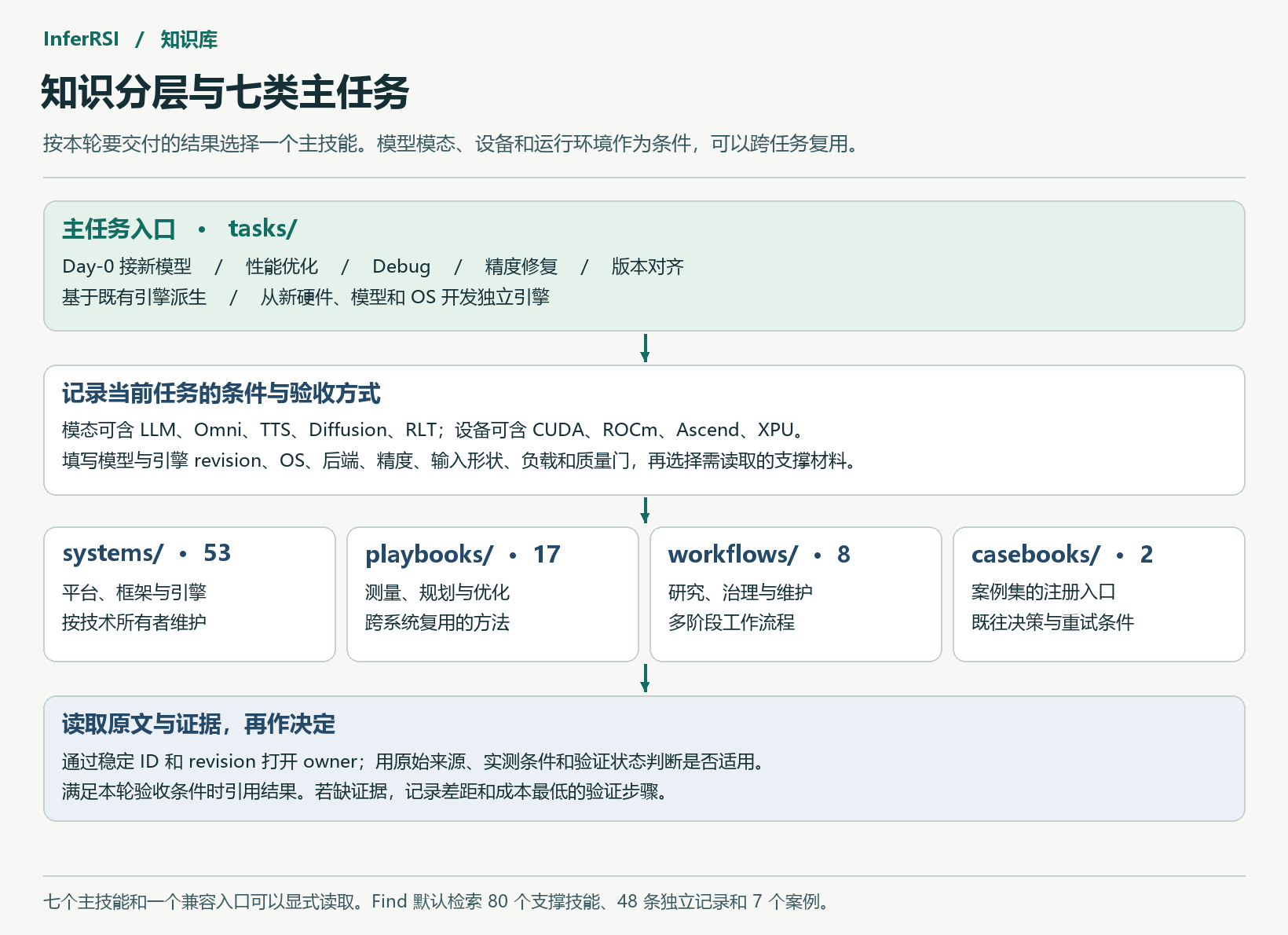
2. One physical knowledge root
flowchart LR
D["src/inferrsi/knowledge/data/"] --> L["skill_library/ · sole child"]
L --> T["tasks/"]
T --> P["7 primary owners: task-day-0, task-performance, task-debug, task-accuracy,<br/>task-version-alignment, task-derived-engine, task-independent-engine"]
T --> H["inference-task-router/ · legacy card paths"]
L --> S["80 supporting owners in systems/, playbooks/, workflows/, casebooks/"]
P & H & S --> O["One SKILL.md owns procedure and typed fields · 88 registered IDs"]
L --> F["records/<stable-id>.json · 48 authored findings"]
L --> CFG["config/ · aliases and research profiles"]
L --> REG["skill-index.json · stable ID → owner and backend"]
L --> BUILD["_compiled/ · inputs.json and _provenance.json"]
O & REG -.->|fingerprint resources and compile host headers at the source commit| BUILD
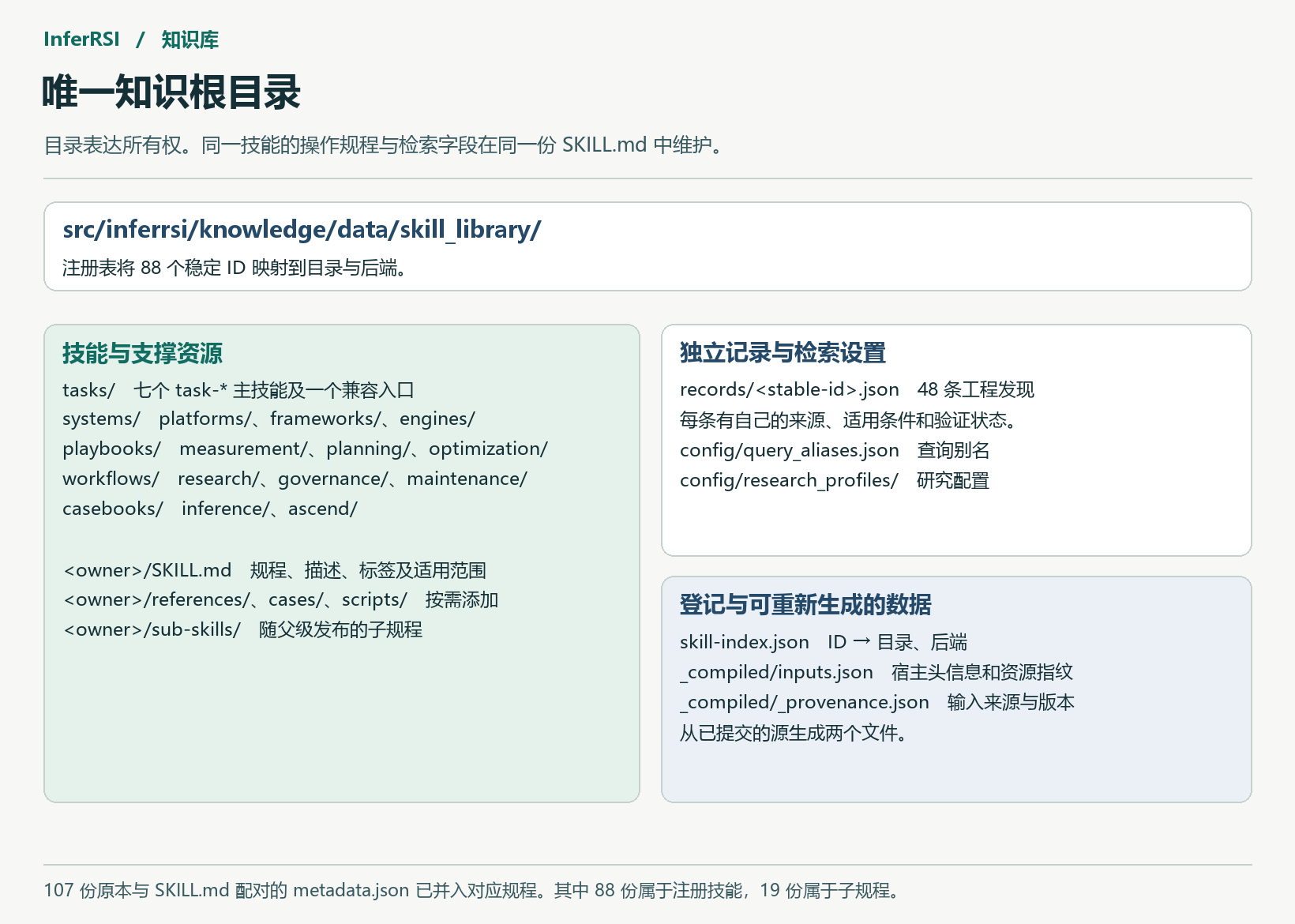
3. Search paths and evidence delivery
flowchart TB
    Q["Main agent receives inference task"] --> P["Choose primary by outcome; skills enter loads its full procedure"]
    P --> R["Capture actual run, acceptance gates and search budget"]
    R --> D["Observation triggers a supporting question"]
    D -->|Known owner| I["Explicit read / resource / capture by ID and revision"]
    D -->|Unknown owner| F["Find lexical ranker · ranked Collect / campaign capture share selector"]
    D -->|Need catalog scope| C["knowledge search · filter by repo, backend, scenario or tier"]
    C -->|Query| F
    C -->|No query| B["Catalog by ID · 48 findings + 88 skill views<br/>default limit 10 · use --limit 136 for all"]
    F --> A["Rank the existing searchable fields and procedure text<br/>Exclude 7 primary skills and legacy router before IDF and limits<br/>default 135 evidence owners · 80 skills + 48 findings + 7 cases"]
    I -->|Authored finding| E["Validate selected record and its dependencies<br/>retain linked-library bundle and pin checks when skill documents are declared"]
    I -->|Other exact owner| V["Check revision, device, model, flags and measurement against this run"]
    A --> H["Find card · limited caveats and withheld count<br/>next_read_content_bytes measures content at Find time"]
    E & H & B --> V
    V --> Z["Read the procedure and structured metadata, or Collect within budget<br/>Pinned resource read returns original SKILL.md bytes"]
    Z --> X["Meets gates → cite reproducible evidence and scope"]
    V --> G["Gap → name missing evidence; test the next distinction or record exhausted budget"]
    G -.->|budget remains| D
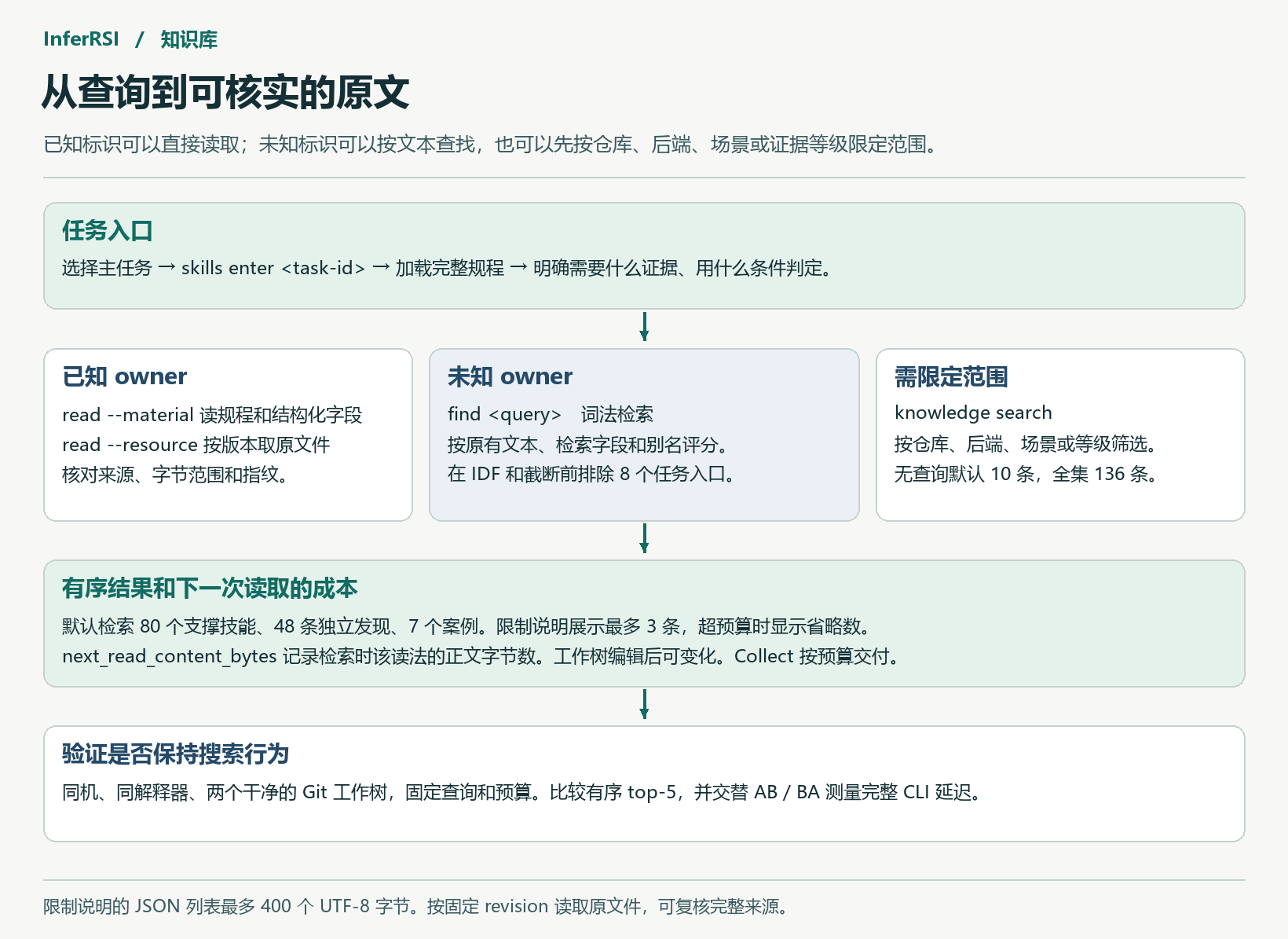
4. Before and after
flowchart LR
    subgraph OLD["main · before #516"]
        A["skill_library/<br/>hardware / frameworks / repositories / methods / workflows"]
        B["repo_packs + knowledge_packs<br/>28 contribution + 9 dependency + 11 peer findings"]
        C["A separate metadata.json beside skill procedures<br/>Generated per-skill JSON records, navigation and shared provenance"]
        D["data/query_aliases.json + research_profiles/"]
    end
    subgraph NEW["PR · knowledge/data/skill_library/"]
        N["tasks/ · 7 first-class primary owners + 1 compatibility router<br/>systems / playbooks / workflows / casebooks · 53 + 17 + 8 + 2"]
        R["records/ · 48 authored findings<br/>IDs, tiers, sources and verification retained"]
        V["Procedure and metadata in one SKILL.md<br/>88 runtime views · 1 registry + 2 generated inputs"]
        P["config/ · aliases + profiles"]
    end
    A -->|move 80 supporting owners and add primary skills| N
    B -->|retain IDs and migrate linked paths| R
    C -->|generate views on demand| V
    D --> P
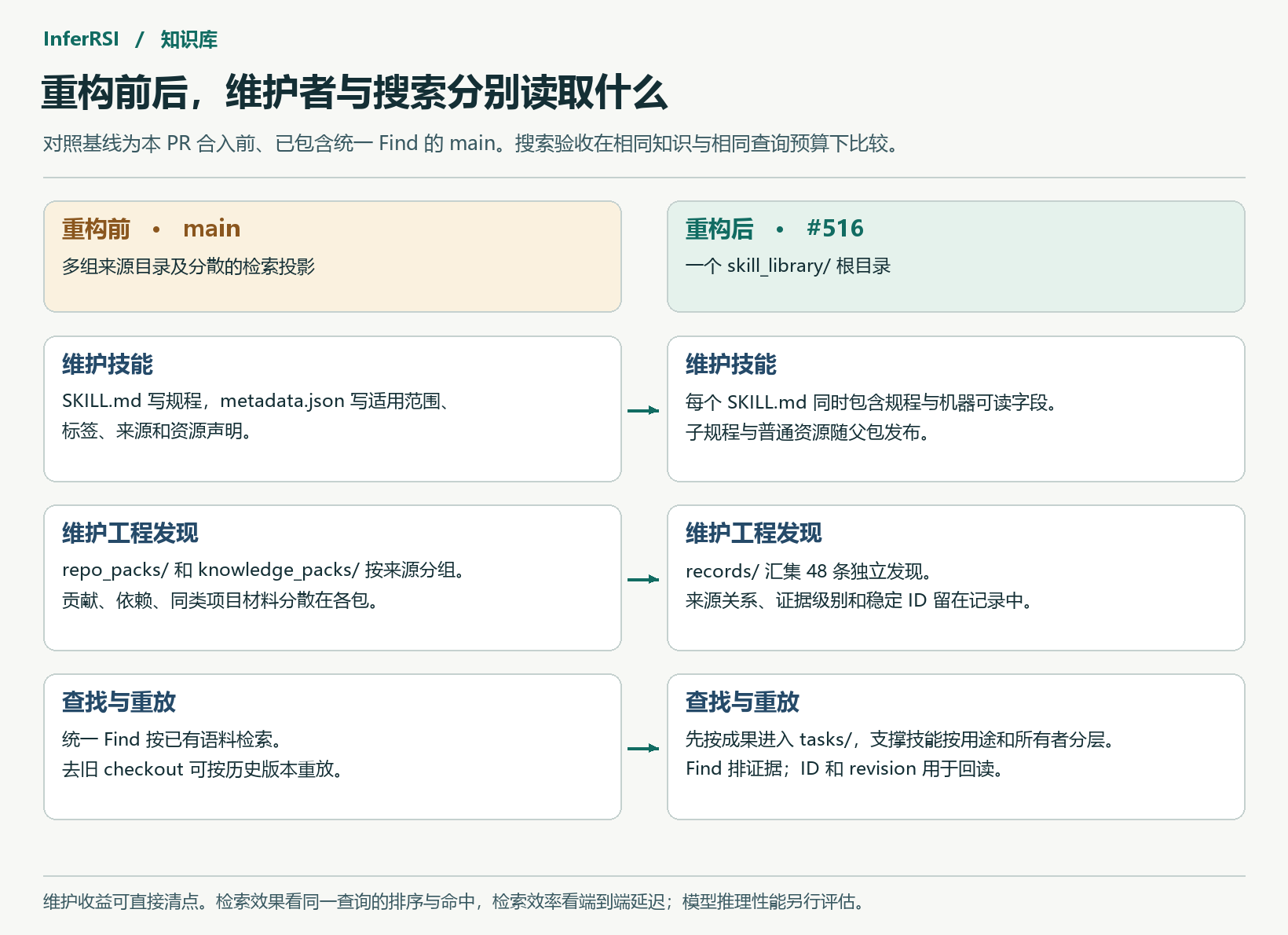
Seven primary skills
| Required primary skill | Inputs to distinguish | Acceptance evidence |
|---|---|---|
| Day-0 model | Model revision, stages, reference implementation, backend | Stage outputs, first end-to-end result, regression fixture |
| Performance | Target metric, workload, bottleneck, quality floor | Paired baseline/candidate runs, quality check and variability |
| Debug | Symptom, last-good configuration, first failing stage | Minimal reproduction, implicated boundary, regression check |
| Accuracy | Reference outputs, dtype, preprocessing, seeds | First divergence, agreed tolerance and end-to-end result |
| Version alignment | Versions of vLLM, vLLM-Omni, vLLM-Ascend and afd-plugin as applicable | Compatibility matrix, paired versions and rollback point |
| Derived engine | Parent revision, inherited APIs and changed paths | Upstream behavior checks and tests of the fork delta |
| Independent engine | Runtime, model format, device, OS and operator availability | Device-native first result, capability gaps and resource bounds |
The main entrypoint loads the primary that owns the user's acceptance criterion. Record hardware vendor, device, backend and OS, model specification and stages, engine and version, run script and flags, benchmark, acceptance criteria, current diagnosis and allowed search space. State unknowns and obtain the smallest missing input that affects the decision.
For example, when a Windows TTS engine still runs after an upgrade but audio quality falls, load task-accuracy before the first search. Fix the prompt, reference audio or codec tokens, seed, preprocessing, dtype and tolerance. Compare the last-good and target stacks on that input. When only the target stack fails, consult version alignment to isolate the changed component. When both stacks diverge, trace the model's earliest mismatching stage. An Ascend 910B1 result can suggest what to measure; verifying a Windows repair requires the original target reproducer and held-out quality checks. If the reference is missing or the allowed budget runs out, record the missing comparison and its impact.
LLM, Omni, TTS, Diffusion and RLT describe workload conditions. CUDA, ROCm, Ascend and XPU describe backends. Mobile devices and Windows add deployment constraints. Check these dimensions against evidence individually. Use only the filters supported by the chosen CLI reader.
Reading and delivery
Use inferrsi skills enter task-performance for the primary procedure. Look up an unknown owner using inferrsi find "TTS quality regression" --limit 5 --no-external --json, then use the returned read arguments. For an ID you already know, use inferrsi read <id> and a recorded revision. A bare or package-qualified standalone engineering record checks its own inputs. A record with linked library documents retains its package dependency checks. Current owners edit their source once, review applicability and regenerate the derived files from the committed source.
The evidence/ change in the final diff against main is limited to three migrated paths in the existing campaign-plan template. The earlier GPU campaign remains available at its historical revision. It has no bearing on the search-parity gate. Earlier run
Independent review and compatibility
Claude Code's Claude Fable 5.2 · Extra independently reviewed the single-file migration through Computer Use. Fable raised host semantics of promoted keys, YAML coercion, ties broken by stable ID, and per-query readability. Codex tested all 107 old objects after parsing, kept the annotation string-valued, and challenged the proposed requirement for identical source-tree fingerprints. Both reviewers agreed to distinguish owner identity, typed metadata, ordered results and the SHA of the exact source bytes.
The 135 searchable (kind, id) pairs, backends and states match main. Compared with the prior PR revision, all 107 typed objects and their existing host headers match; 44 other SKILL.md files originally had no companion. Directory links and two obsolete authoring instructions changed, so the raw documents do change. The build checks the full YAML interpretation against the base-install decoder. The historical checkout reader still supports separate metadata files.
A 100,000-byte Collect test exposed a genuine regression. Including machine metadata made the required set 125,623 bytes. The corrected AFD context contains seven resources and both licenses, 77,076 bytes on main and 77,206 on this PR. The procedure view records a digest of the delivered bytes, the full source digest and reconstructable half-open byte ranges; a pinned resource read still returns the original file. Fable accepted the frozen timing protocol and asked to verify total-budget handling. The frozen benchmark times Find; this Collect case separately tests delivery.
Fable's final review asked whether the fixed queries exercised the two procedures with edited prose. Neither pytorch nor npu-skill-factory appeared in their top five. Two supplementary, untimed probes named each procedure's distinctive work. Both versions placed the intended owner first with a working read command, and both top-five lists matched. These probes were chosen after the main run and are excluded from its 49 queries and timing statistics.
The installed-wheel check independently compares a pinned raw SKILL.md against the packaged resource, then reconstructs the delivered procedure from its byte ranges and checks both SHA-256 values. The built wheel contains 761 package resources; the previous 868 included the 107 removed companions. The base wheel exposes 135 search owners without PyYAML. Installed-wheel regression
Separate follow-up for agent task outcomes
Compare A (old layout), B (new layout, direct search as an evaluation-only ablation) and C (the shipped primary-skill-first agent entrypoint). Keep source material, hardware, model, tool permissions, token budget and task distribution fixed. Start with four held-out tasks per family, including compound goals and cases with no target evidence. Use paraphrases that omit the task-card names and a blinded assessor. Measure time and steps to the first applicable source, owner top-three hit rate, incorrect evidence use, correct abstention, task completion and cost. Record engineering time, accelerator hours, model spend and ongoing curation. The observed ranking comparison is a regression check. A benefit or service-performance verdict remains INCONCLUSIVE pending the pilot.
The pilot owner is the maintainer-designated evaluation lead; the maintainer should name that person before the pilot. Deployment owners validate private captures on the corresponding retained snapshot before rollout. The proposed primary metric is binary top-three applicable-owner hit rate on answerable tasks. Require zero decrease between paired arms on that metric; a higher false-transfer count fails rollout. Report top-five applicable-source recall as a secondary metric and report time/cost separately. Run four held-out tasks per task type (28 in total), balance A/B/C order and use a fresh session for each arm. Report A→B layout and B→C routing deltas separately. The host selects the primary by the requested deliverable. It opens the complete instructions before the first supporting search. XPU is a target condition only. The caller explicitly reports applicable evidence, a bounded analogue or a gap. This protocol is proposed for approval before the first scored run.
Use an unseen Windows TTS regression as a negative transfer control, paired with a documented Ascend TTS workload as a positive control. Score both unjustified reuse and unjustified abstention. In addition to quality and time-to-evidence, track files edited and time spent merging the two generated files per accepted contribution.
Earlier layout migration, paired retrieval table, historical timings and review
Earlier review decisions are preserved in the discussion. Required task entrypoints · Run-specific decisions · Exact reads and ranking · Projection and search evidence review
Activity
Dong1017 commentedon Nov 19, 2026
Posted by Dong-bot, an automated agent acting on behalf of @Dong1017 (always-on-bot, model claude-sonnet-5-5).
Assessment: This is a well-scoped, reviewable proposal. It reorganizes the 80 registered skill bundles from hardware/framework/repo/method/workflow directories into four purpose-based groups: systems, playbooks, workflows and casebooks. It also adds one registered entry,
tasks/inference-task-router, with seven route cards. I'd treat it as ready for design review, but not yet for acceptance. The blockers are the evidence gaps and questions below. I read only the issue body. I did not open the linked branch, the migration manifest, the docs, or the images, and I ran nothing.What I checked (arithmetic in the body only)
Gaps and risks
repo_packs/knowledge_packsreferences. The stable ID → path index covers ID lookups. The body doesn't say whether old directory paths get redirects, a deprecation window, or a hard failure with a clear error. Please state which.findoutput present an Ascend or CUDA result as applicable to a different target. Please state how the route-card output marks "analogue" versus "applicable on target". Also confirm that XPU is covered only by condition text and not by a filter that silently returns nothing.findare intentionally separate. That is sound, and excluding the entry before IDF avoids skewing ranking. One check is still worth stating: confirm that the IDF corpus and scores for the 80 skills are unchanged by the move. Path tokens, if indexed, could change them.Clarifying questions
evidence/orcampaign/pinned to old skill paths? The body says frozen experiments are retained, so do their validators still pass unchanged?On the three review areas the issue asks for
skills show, rankedfind, direct read) are clear. I'd accept it with points 5–7 recorded.Suggested next step: the author posts the PR or head SHA with the replay results and manifest check from points 1–2. A reviewer then confirms those results on that head. The maintainers keep acceptance and closure, as the body states. I'm not accepting or closing anything from this comment.
(Dong-bot, authorized delegate; first-pass triage only.)
david6666666 commentedon Nov 19, 2026
Please record the integration order with #507 and rerun the migration replay on the combined checkout. Both PRs change
knowledge_find.py,research.py, and retrieval tests: #507 changes which operations share Find, while #516 moves the inputs and excludes the task entry. The current 36/36 result compares only #516 with9b81c9b. For the combined acceptance check, compare old and new layouts under the same ranker, verify the task entry remains directly readable but absent from default evidence ranking, and rerun the pinnedfind→readpath. That separates intended ranking changes from layout regressions.[-]task: route seven inference workflows through a purpose-based knowledge library[/-][+]Organize inference knowledge in one skill_library and validate task-oriented retrieval[/+]zengchuang-hw commentedon Nov 19, 2026
PASS
独立方案检视,不代表 #516 实现验收或检索收益。统一物理目录、保留 authored record 来源层级,以及将七类任务卡用作入口而非适用性证明,这三个边界一致。实际 router 也要求继续查完整目录,区分目标匹配证据、方法类比和缺失证据。
在 pilot 开始前建议冻结三件事:
docs/knowledge-layout.md写 top-five applicable-source recall。两者衡量的问题不同;可以都报,但需预先指定主指标、判分规则和可接受退化幅度。36 条查询的一致性支持迁移回归,不证明路由收益。现有 Windows 计时也只支持该次 record 加载测量,不证明完整查询提速。收益结论继续保留 INCONCLUSIVE。已静态核对方案、router 和指定文档;未运行测试或查询 CI。
david6666666 commentedon Nov 19, 2026
Now that #507 landed, there is a concrete case-migration check to add. Main sets
backend: cudaoncase.admission-drain-occupancy,case.drama3-rejected-directions,case.qwen-b300-rejected-directions, andcase.vllm-gdn-source-contract, andbackend: ascendoncase.qwen-ascend-rejected-directions. The moved files at #516e10721epredate those annotations. Please carry the five values through the rename, verify backend-filtered Find and capture against current main, and regenerate the case-pin rows using current main as the migration baseline. This separates #507’s intentional case changes from any revision changes caused by the move itself.zengchuang-hw commentedon Nov 19, 2026
PASS
这条 case 迁移要求已做静态增量核对:比较 #507 合入的
9c7b7b05和 #516 的f49cd4f7,五个改名后的 case 均保留原 backend(四个 CUDA、一个 Ascend)。迁移表也以这次布局变更为边界分别列出旧/新 checkout revision,不把 #507 对 case 内容的变更归到改名上。Find/Capture 仍应按原 backend 和 case ID 区分,不能仅以新路径存在作为证据。这个结论只覆盖本轮的静态元数据核对;没有运行 backend-filtered Find、Capture 或 CI。先前的 held-out 试验和路由收益仍是单独验收。
zengchuang-hw commentedon Nov 19, 2026
PASS
09:49 UTC 正文的试验协议已补齐上一轮口径建议:主指标明确为可回答任务的 top-three applicable-owner 命中率;top-five source recall 为副指标;七类各四题,共 28 题;每臂新会话、平衡顺序,并分开报告 A→B 和 B→C。这比把 36 条查询的排名回归当成上线收益更可判定。
试验前建议由负责人冻结逐题的“可回答/无适用证据”、可接受 owner 和类比边界;报告中列出各配对臂的命中退化与恢复,不让净持平掩盖个别任务的回归。方案通过,不等于收益或 rollout 通过。未运行试验或查询 CI。
david6666666 commentedon Nov 19, 2026
Single-B300 field validation protocol
Frozen before generating any latency samples. Control KB
a3e33851981f1ecdc8b73d7b62633cc598e5d5ae, proposed KBc27a359d0ec5c11551b3d4c77ddfa3068cbf1c36, upstream vLLM-Omni main51f54de16b08416182926b8f071034422561f99c, MiniMaxAI/MiniMax-H3-Image revision8ced60068623def5b74b4d10558117cb61d6482d.The published diagrams in this issue and #516 describe the architecture under test. This comment records the protocol, before any measured performance claim.
zengchuang-hw commentedon Nov 19, 2026
PASS
单 B300 协议增量检视,仅就协议。固定软件、模型和 6 步工作量,使用同一物理卡、基线 A/A 和像素一致性作为边界是合理的;像素相同的结论只覆盖这组 prompt/seed。
两点建议在采样前落入记录:每个候选都按同样的准入、计时和退化规则报告;挑选最强候选所用的探索样本与反向顺序确认样本分开,不用后者反复挑赢家。两个调查者各只跑一个 KB 臂时,操作者差异与 KB 差异无法分离;如果不增加复测,把结果表述为两次受控案例,别归因为 KB 优劣。单 B300 协议不替代 28 题检索试验。未运行实验或查询 CI。
zengchuang-hw commentedon Nov 19, 2026
PASS
增量检视最新 Single-B300 结果的表述口径,承接 上轮协议检视。八个候选未证明在冻结像素门槛下有 20% 降时;我复核了六条固定查询的留存数据,旧、新布局的 top 5 ID 和顺序一致。未见把这些结果误报成新版布局更优。
建议在后续总结继续区分:固定查询是探索后选取的回放,不能替代预冻结的 28 题盲评;每臂仅一位调查者且启动失败计时口径不同,不能将两者的端到端耗时差归因于布局。#500 的分层披露收益也需要单独对照。本轮未重跑 B300,只核查了留存证据和结论边界。
zengchuang-hw commentedon Nov 19, 2026
PASS
仅限新版离线 Find 回归门槛与已公布数据的一致性。按 留存 JSON 复算,两轮各 28 对的候选/基线中位数比为 0.7005 和 0.7190;首轮 49 条查询的排序和读取命令标记逐项一致。第二轮公布了排序摘要和哈希,未重跑核实逐条列表。
建议验收文字继续区分:读取命令存在不等于材料已成功读出;15/17 验的是材料类别而非适用性;19 条证据缺口题都仍有返回,不能据此认定已学会拒绝误用。耗时结论只适用于本次 Windows 离线环境和整项改动,不能归因到某一项布局调整或外推到服务性能。28 题 A/B/C 仍是独立的待验收协议:先冻结适用标签、错误迁移与拒答的判分规则,再分开报告布局和入口增益。未执行仓库代码或实机实验。