

more room for play.
debuff is an open-source toolkit for 2D browser games that handles the basics for you (the game loop, controls, sound, levels, testing, shipping) so you get to that game sooner and spend your time on what makes it yours.
- The groundwork, done. Start from a running game in under a minute. Crisp pixels on every screen, keyboard, touch and gamepad, sound that plays, levels from Tiled or LDtk, and a build you can put anywhere on the web, game portals like Poki and CrazyGames included (publishing guide).
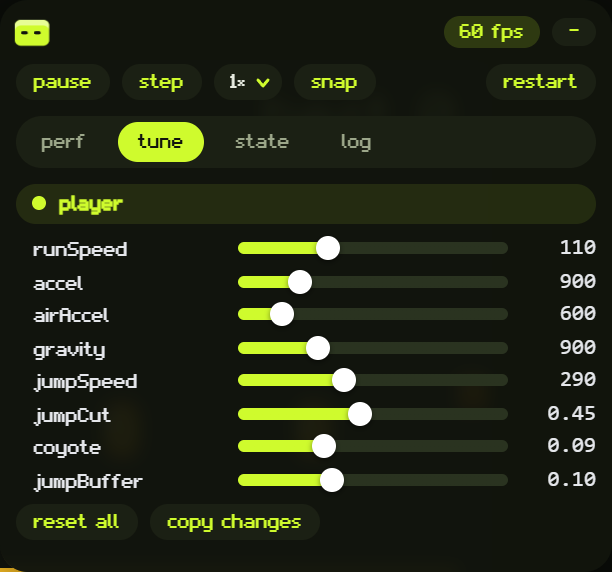
- Tune it until it feels right. Speeds, timings and other feel values become live sliders in the dev panel, with undo.
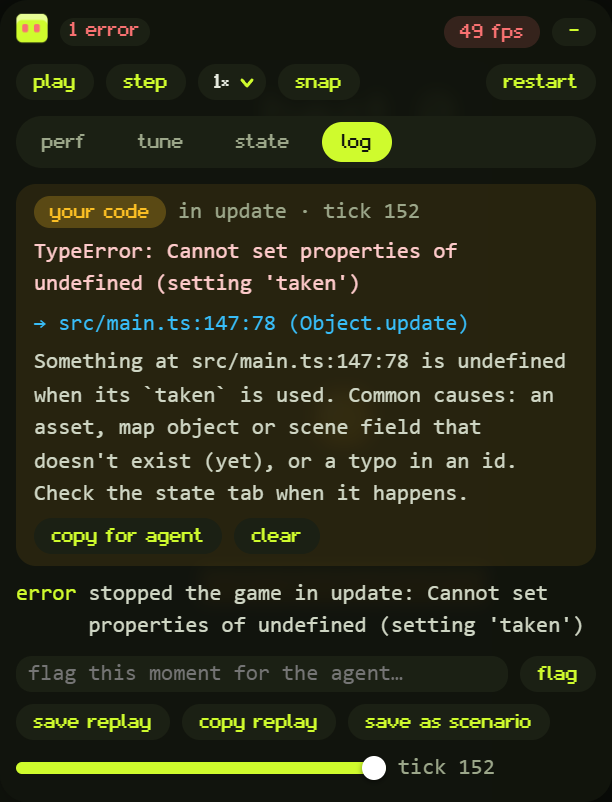
- When something breaks, it tells you. Errors say whose bug it is and point at the line. Replays and scenario tests bring a bug back exactly, so you can fix it and move on.
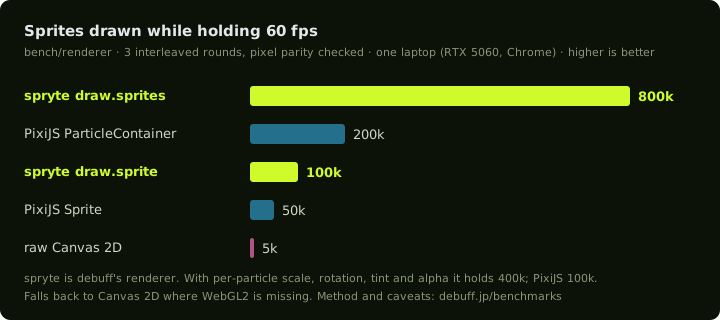
- Room to grow. Small (the starter ships at about 19 kB) and fast: its renderer, spryte, is 2–3.8× faster than PixiJS on like-for-like workloads and draws up to 800,000 position-only sprites at 60 fps on our test laptop (benchmarks), so the engine doesn't hold your idea back.
- Agents help if you want them, you decide. Coding agents can play the game you have open, read what's happening and check their changes. Creative calls stay with you.
Status: 0.5, early development. APIs will change, and feedback from real games shapes them.
You need Node.js 22 or newer.
npm create debuff@latest my-game
cd my-game
npm install
npm run dev
Open the URL it prints, then press </kbd> in the game for the dev panel. Edit src/main.tsand the game reloads. For a tilemap platformer instead of the minimal starter, add-- --template platformerto the first command,-- --template mossfellfor a top-down adventure, or-- --template squish for a squishy match-3 that plays well on phones. pnpm, Yarn and Bun work too (pnpm create debuff`, and so on).
New projects include a .mcp.json, so a coding agent like Claude Code can play and inspect the game you have open. See the agent guide.
Working on debuff itself? Clone the repo, then run npm install and npm run build. cd templates/platformer && npx debuff dev runs a template against your local packages, and the repo's .mcp.json points the MCP server at it. See CONTRIBUTING.
| Raw canvas + JS | debuff | |
|---|---|---|
| Sprites at 60 fps | ~5,000 | ~100,000 one call each, ~800,000 in bulk (spryte: WebGL2 with a Canvas 2D fallback) |
| Small game, shipped | what you write | ~19 kB brotli for the starter, everything included |
A crash in update |
the loop dies silently | stops, says whose bug it is, links the source line |
| Tuning feel | edit, reload, replay | sliders while you play, with undo and copy back to code |
| AI agents | read code and guess | play your game: state, frames and errors, and you see what they did |
More in Why debuff. Agents can start from llms.txt.
| Package | What it does |
|---|---|
@debuffjp/core |
Game loop, fixed-step clock, seeded RNG, scenes, camera, sprites, params, storage, frame stats |
@debuffjp/input |
Keyboard and pointer/touch with per-step edges and programmatic input |
@debuffjp/assets |
Manifest-driven loader with preload groups and actionable errors |
@debuffjp/audio |
Web Audio buses, autoplay unlock, parametric synth |
@debuffjp/tilemap |
Tilemaps: culled batched rendering, tile collision, Tiled and LDtk import |
@debuffjp/ui |
Screen transitions, menus and framed panels |
@debuffjp/juice |
Tweens, easing, pooled particles, trails, squash-and-stretch |
@debuffjp/dev |
Dev panel (perf, tune, state, explained errors, replays, rewind) and window.__DEBUFF_DEV__, stripped from production |
@debuffjp/cli |
debuff dev · build · assets · test · scenario · fuzz · inspect · report |
myaku |
Frame profiler for any web game: finds the hitches players feel and says why in plain words. Standalone; debuff dev runs it for you |
keiko |
Fast, deterministic logic tests for any web game: the real game in Node, no browser. Standalone; debuff integrates it |
create-debuff |
npm create debuff scaffolder |
@debuffjp/mcp |
MCP server: agents inspect, build, test and play your game |
debuff create [dir]     scaffold from a template
debuff dev              dev server, hot reload, asset manifest watching
debuff build            production build + size report (fails on dev leaks)
debuff assets           regenerate manifest, list unused assets
debuff test             logic tests (keiko): the real game in Node, no browser, in milliseconds
debuff scenario         run scenarios/*.json headless, compare captures
debuff fuzz             random playtesting; crashes come back as replay files
debuff inspect          JSON project summary for agents
debuff report           size report for an existing dist/
Every command accepts --json for machine-readable output where applicable.
packages/    browser runtime libraries (@debuffjp/*)
tooling/     Node-side tools (CLI, scaffolder)
templates/   starter templates; built and scenario-tested in CI
docs/        architecture, roadmap, decisions (docs/adr)
- Discord: the debuff community's home. Ask questions, share games, find jams.
- debuff.jp · Issues
- Contributing · Agent guide · Governance
- Code of conduct · Security · Versioning and stability
- Architecture · Roadmap · Plugins · Decisions
MIT