


A hand-curated, regularly updated guide to 43 of the best Java books, organized by skill level — from your first "Hello, World" to JVM internals, Spring, and interview prep.
📖 Browse the full site → mohsenk.github.io/JavaBooks — a nicer way to browse, with search-friendly category pages, always in sync with the list below.
No filler, no paid placements — see how books are chosen.
- 🌱 Beginner Java Books
- 📘 Intermediate Java Books
- 🔧 Advanced Java and Concurrency
- 📐 Design Patterns and Architecture
- 🍃 Spring and Enterprise Java
- 🎯 Interview Prep and Certification
- Contributing
New to Java or to programming altogether? These are the best Java books for beginners in 2026 — hands-on, well-tested guides that take you from zero to writing real object-oriented programs. Each title below was picked for how clearly it explains core concepts like variables, classes, and control flow before moving on to Java's more advanced features. → Full list on the site
 |
Head First Java: A Learner's Guide to Real-World Programming, 3rd Edition 🏷️ Best for: First-time programmers who want an engaging, visual approach A visually driven, puzzle-and-story approach to learning Java that trades dry syntax dumps for exercises, illustrations, and 'brain-friendly' explanations. |
 |
Java: The Complete Reference, 13th Edition 🏷️ Best for: Beginners who want one thorough reference that grows with them A comprehensive, encyclopedic tour of the Java language and core API, updated for Java SE 21 with features like pattern matching in switch and virtual threads. |
 |
Think Java: How to Think Like a Computer Scientist, 2nd Edition 🏷️ Best for: Students and self-learners who want a structured, course-like intro A concise, classroom-tested introduction that treats Java as a vehicle for learning to think like a programmer, not just memorize syntax. |
 |
Core Java, Volume I: Fundamentals, 13th Edition 🏷️ Best for: Motivated beginners who want depth without marketing fluff A rigorous, example-heavy walk through Java fundamentals from a long-time trainer and well-known Java author, updated to reflect Java 21. |
 |
Murach's Java Programming, 6th Edition 🏷️ Best for: Absolute beginners who like a self-paced, guided workbook style A paced, exercise-driven textbook aimed squarely at people with zero programming background, built around Murach's signature 'paired pages' format that pairs explanation with runnable code side by side. |
 |
Java: A Beginner's Guide, 9th Edition 🏷️ Best for: Readers who want Schildt's teaching style in a lighter package A step-by-step, no-prior-experience-assumed guide from the author of Java: The Complete Reference, walking readers from installing a JDK through writing, compiling, and running their first programs. |
 |
Java For Dummies, 8th Edition 🏷️ Best for: Total beginners who want the gentlest possible on-ramp A friendly, jargon-light entry point that assumes nothing and explains Java concepts through plain-language analogies before showing the code. |
 |
Beginning Java Programming: The Object-Oriented Approach 🏷️ Best for: Career-changers and students wanting a business-oriented intro Developed from a university course the authors taught, this book builds up object-oriented thinking gradually alongside Java syntax, using an IDE-based workflow and exercises based on realistic business scenarios. |
Once you're comfortable with Java syntax, these are the best intermediate Java books for leveling up your skills — collections, generics, streams, lambdas, and cleaner idioms that separate a working programmer from a confident one. Each pick below focuses on writing more expressive, maintainable Java rather than absolute-beginner basics or deep JVM internals. → Full list on the site
 |
Effective Java, 3rd Edition 🏷️ Best for: Java developers who want to write more idiomatic, defensible code Joshua Bloch's item-by-item guide distills decades of API design experience from his time leading Java platform work at Sun and Google into concrete, justified rules covering generics, enums, lambdas, streams, and object lifecycle. |
 |
Modern Java in Action: Lambdas, Streams, Functional and Reactive Programming 🏷️ Best for: Developers moving to functional-style, stream-based Java This is the book that reframes how you think about Java once lambdas and streams enter the picture. |
|
Core Java, Volume II—Advanced Features, 12th Edition 🏷️ Best for: Developers who want a deep reference beyond core syntax The companion to Horstmann's Volume I, this book picks up once you know core syntax and moves into streams, XML, networking, databases, internationalization, and security APIs. |
 |
Java by Comparison: Become a Java Craftsman in 70 Examples 🏷️ Best for: Developers who want tighter, more professional-looking code A short, focused book built entirely around side-by-side before-and-after code examples — each one taking a common but flawed snippet and showing exactly how and why to improve it. |
 |
Functional Programming in Java: Harness the Power of Streams and Lambda Expressions, 2nd Edition 🏷️ Best for: Developers wanting a practical, exercise-driven functional-Java primer A hands-on introduction to thinking functionally in Java, built around small, practical exercises rather than theory. |
 |
The Well-Grounded Java Developer, 2nd Edition 🏷️ Best for: Developers catching up on modern Java and its ecosystem Written explicitly for developers past the beginner stage, this book brings you up to speed on everything that changed in Java from version 8 onward — modules, newer language features, build tooling with Maven and Gradle, and a broad tour of the wider JVM ecosystem including Kotlin. |
 |
JUnit in Action, 3rd Edition 🏷️ Best for: Developers who want to write real, maintainable test suites A practical, thorough guide to testing Java code well, built around JUnit 5's newer architecture — nested and parameterized tests, dependency injection, and mocking with Mockito. |
These books go beyond day-to-day application code into how the JVM actually runs your programs — Java concurrency and multithreading, garbage collection, JIT compilation, generics internals, and performance tuning. They're written for developers who already know Java well and want to diagnose real production problems, not just follow generic tuning checklists. → Full list on the site
 |
Java Concurrency in Practice 🏷️ Best for: Developers who need a rigorous foundation in Java concurrency Written by Brian Goetz together with several members of the JSR-166 expert group (including Doug Lea and Joshua Bloch), this book breaks down the theory and practice of writing correct, thread-safe Java code — covering the Java Memory Model, locks, atomics, and the java.util.concurrent library. |
 |
Java Performance: In-Depth Advice for Tuning and Programming Java 8, 11, and Beyond, 2nd Edition 🏷️ Best for: Engineers tuning JVM performance and GC behavior in production Scott Oaks explains how the HotSpot JVM actually executes and optimizes code, then applies that to garbage collection tuning, JIT compilation, threading, and I/O performance. |
 |
Optimizing Java: Practical Techniques for Improving JVM Application Performance 🏷️ Best for: Practitioners who want a tooling-driven, evidence-based approach to JVM tuning Evans, Gough, and Newland lay out a measurement-first approach to Java performance work, showing how to benchmark correctly, read JIT compiler output, and reason about memory and concurrency costs before making changes. |
 |
Java Performance Companion 🏷️ Best for: JVM specialists debugging GC internals and using the Serviceability Agent Written by current and former Oracle JVM engineers, this book picks up where general performance guides leave off, going deep on the Garbage-First (G1) collector's internals and the HotSpot Serviceability Agent for postmortem diagnosis. |
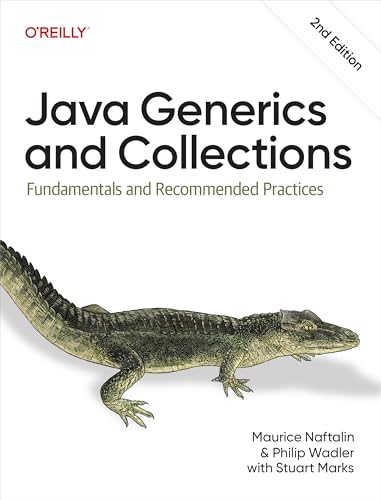 |
Java Generics and Collections: Fundamentals and Recommended Practices, 2nd Edition 🏷️ Best for: Developers who want to master Java's generics and collections type system Naftalin and Wadler give one of the clearest explanations available of how Java generics actually work under erasure, including the wildcard rules and corner cases that trip up even experienced developers, paired with a thorough tour of the Collections Framework. |
 |
Netty in Action 🏷️ Best for: Developers building high-throughput, non-blocking network servers in Java Written by one of Netty's core maintainers, this book explains the asynchronous, event-driven Netty framework that underlies many high-throughput Java network servers — channels, event loops, and codecs for building non-blocking clients and servers. |
These are the foundational reads Java developers reach for when they want to move past working code toward well-structured code — the original design pattern catalog, the books that shaped how the Java ecosystem thinks about clean code and clean architecture, and the enterprise and domain modeling classics that still underpin Spring-style application design today. → Full list on the site
 |
Design Patterns: Elements of Reusable Object-Oriented Software 🏷️ Best for: Developers who want the original vocabulary behind object-oriented design patterns Written by the 'Gang of Four,' this is the book that gave the industry a shared vocabulary of 23 object-oriented patterns, from Singleton to Visitor. |
 |
Head First Design Patterns: Building Extensible and Maintainable Object-Oriented Software, 2nd Edition 🏷️ Best for: Developers who want design patterns taught through examples rather than theory A friendly, visually driven walkthrough of the same core design patterns the GoF catalog defined, but explained through worked scenarios, diagrams, and running Java code rather than dense prose. |
 |
Clean Code: A Handbook of Agile Software Craftsmanship 🏷️ Best for: Developers who want cleaner, more maintainable code at the function and class level Robert Martin's argument for treating naming, functions, formatting, and error handling as first-class design decisions, illustrated almost entirely with Java code and Java-centric refactoring case studies. |
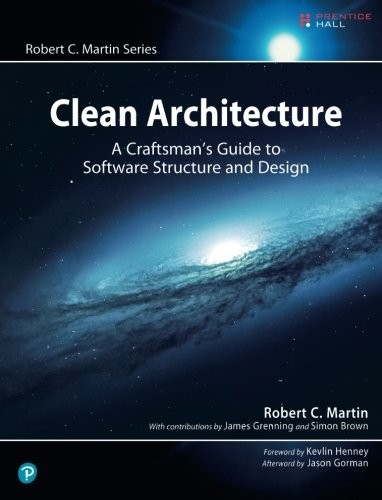 |
Clean Architecture: A Craftsman's Guide to Software Structure and Design 🏷️ Best for: Developers and architects designing the high-level structure of an application Martin's follow-up to Clean Code zooms out from individual methods to whole-system structure, arguing for dependency rules that keep business logic independent of frameworks, databases, and UI. |
 |
Patterns of Enterprise Application Architecture 🏷️ Best for: Backend developers designing the data and service layers of enterprise systems A catalog of over 40 recurring solutions for structuring data-heavy business applications — layering, object-relational mapping strategies, session state, and concurrency patterns like Optimistic Offline Lock. |
 |
Domain-Driven Design: Tackling Complexity in the Heart of Software 🏷️ Best for: Developers and architects tackling complex business domains, not just CRUD apps Known in the community as 'the Blue Book,' this is the source text for domain-driven design: ubiquitous language, bounded contexts, aggregates, entities versus value objects, and modeling software around a shared understanding of the business domain. |
 |
Refactoring: Improving the Design of Existing Code 🏷️ Best for: Java developers who want a systematic, example-driven approach to improving existing code This is the 1st edition, whose worked examples and refactoring catalog are written in Java — note that Fowler's 2018 2nd edition rewrote all the examples in JavaScript, so this original printing is the one to pick for a Java-specific read. |
 |
Growing Object-Oriented Software, Guided by Tests 🏷️ Best for: Developers who want to see TDD and OO design practiced together on a real Java codebase A practical, project-length walkthrough of test-driven development done at the object-design level, built end-to-end in Java using JUnit and the authors' own mocking library (a forerunner of jMock/Mockito-style thinking). |
Spring Framework and Spring Boot power the majority of enterprise Java systems in production today, and this shelf collects the best Spring Boot books and enterprise Java references for building REST APIs, securing applications, and designing cloud-native microservices. Whether you're learning Spring for the first time or architecting distributed systems, these titles cover the practical patterns and tools real teams rely on. → Full list on the site
 |
Spring in Action, Sixth Edition, 6th Edition 🏷️ Best for: Java developers who want a comprehensive, up-to-date map of the Spring Boot ecosystem The long-running flagship guide to the Spring Framework, rewritten for Spring 5.3 and Spring Boot 2.4. |
 |
Spring Start Here: Learn what you need and learn it well 🏷️ Best for: Developers new to Spring who want the core concepts explained clearly before diving into bigger projects A gentler on-ramp into Spring than most reference books, built around small, focused examples rather than a single large project. |
 |
Spring Security in Action, Second Edition, 2nd Edition 🏷️ Best for: Spring developers who need to implement authentication, OAuth2, and API security correctly A focused, hands-on treatment of securing Spring applications, updated for Spring Boot 3 and modern OAuth2/OpenID Connect flows. |
 |
Spring Microservices in Action, Second Edition, 2nd Edition 🏷️ Best for: Spring Boot developers moving from a monolith toward production-grade microservices A practical walkthrough of building microservices on Spring Boot and Spring Cloud, using a running example service built out chapter by chapter. |
 |
Cloud Native Java: Designing Resilient Systems with Spring Boot, Spring Cloud, and Cloud Foundry 🏷️ Best for: Experienced Spring developers modernizing legacy Java applications for the cloud Written by a longtime Spring Developer Advocate, this book explains how to reshape existing Java applications into cloud-native services rather than starting from a greenfield tutorial. |
 |
Java Persistence with Hibernate, Second Edition, 2nd Edition 🏷️ Best for: Backend developers who need a rigorous understanding of JPA and Hibernate internals Written in large part by Hibernate's original creator, this is a deep, example-driven dive into object-relational mapping rather than a quick-start guide. |
 |
Microservices Patterns: With examples in Java 🏷️ Best for: Architects and senior developers designing or untangling a microservices system A catalog of over 40 named patterns for microservice architecture, covering service decomposition, saga-based transactions, event sourcing, and inter-service querying, with Java code samples throughout. |
 |
Spring Boot: Up and Running: Building Cloud Native Java and Kotlin Applications 🏷️ Best for: Developers who want a fast, practical path to a deployable Spring Boot application A pragmatic, task-oriented introduction to Spring Boot from a longtime Spring advocate, covering both Java and Kotlin usage side by side. |
Whether you're chasing an Oracle Java certification or prepping for a coding interview at a Java-heavy shop, the right book turns scattered exam objectives and algorithm trivia into a focused study plan. This shelf pairs the current OCP Java certification study guide with the most trusted Java-focused coding interview references, so you can pick the one that matches whether you're closing a certification exam or a whiteboard round. → Full list on the site
 |
OCP Oracle Certified Professional Java SE 21 Developer Study Guide: Exam 1Z0-830 🏷️ Best for: Preparing for the current Oracle Java SE 21 developer certification exam A chapter-by-chapter walkthrough of every objective on Oracle's current single-exam Java SE 21 Developer certification (1Z0-830), from records and sealed classes to virtual threads and pattern matching. |
 |
OCA: Oracle Certified Associate Java SE 8 Programmer I Study Guide: Exam 1Z0-808 🏷️ Best for: Starting out on the Oracle Java certification path with core language fundamentals Covers the foundational 1Z0-808 exam objectives, including Java syntax, OOP fundamentals, exception handling, and the functional-programming basics introduced with Java 8's lambdas and streams. |
 |
Cracking the Coding Interview: 189 Programming Questions and Solutions, 6th Edition 🏷️ Best for: General technical coding interview prep with Java-based sample solutions The best-known general coding interview book on the market, built around 189 practice problems with worked solutions and a walkthrough of the interview process itself, from resume screening to whiteboard etiquette. |
 |
Elements of Programming Interviews in Java: The Insiders' Guide 🏷️ Best for: Deep, Java-specific practice for rigorous coding interview rounds A dense, Java-specific problem set of 300+ interview questions, organized by data structure and algorithmic technique, with tested Java implementations and discussion of edge cases and complexity trade-offs. |
|
Java Coding Problems: Become an expert Java programmer by solving over 250 brand-new, modern, real-world problems, 2nd Edition 🏷️ Best for: Practicing modern, real-world Java problems beyond classic algorithm drills A problem-and-solution format book that uses modern Java (through JDK 21) to work through practical coding challenges spanning strings, collections, generics, functional programming, concurrency, and performance tuning. |
|
The Complete Coding Interview Guide in Java: An effective guide for aspiring Java developers to ace their programming interviews 🏷️ Best for: A guided, all-in-one Java coding interview prep course Structures interview prep in two parts: a shorter section on non-technical interview rounds (resumes, behavioral questions) followed by a larger set of 200+ Java coding problems across arrays, strings, linked lists, sorting, searching, concurrency, and functional programming. |
Found an outdated edition, a broken link, or think a book deserves a spot? See CONTRIBUTING.md — all book data lives in one file (docs/_data/books.yml) that powers both this README and the live site.
This project is licensed under the MIT License.